Strings
Explanation
The Joke
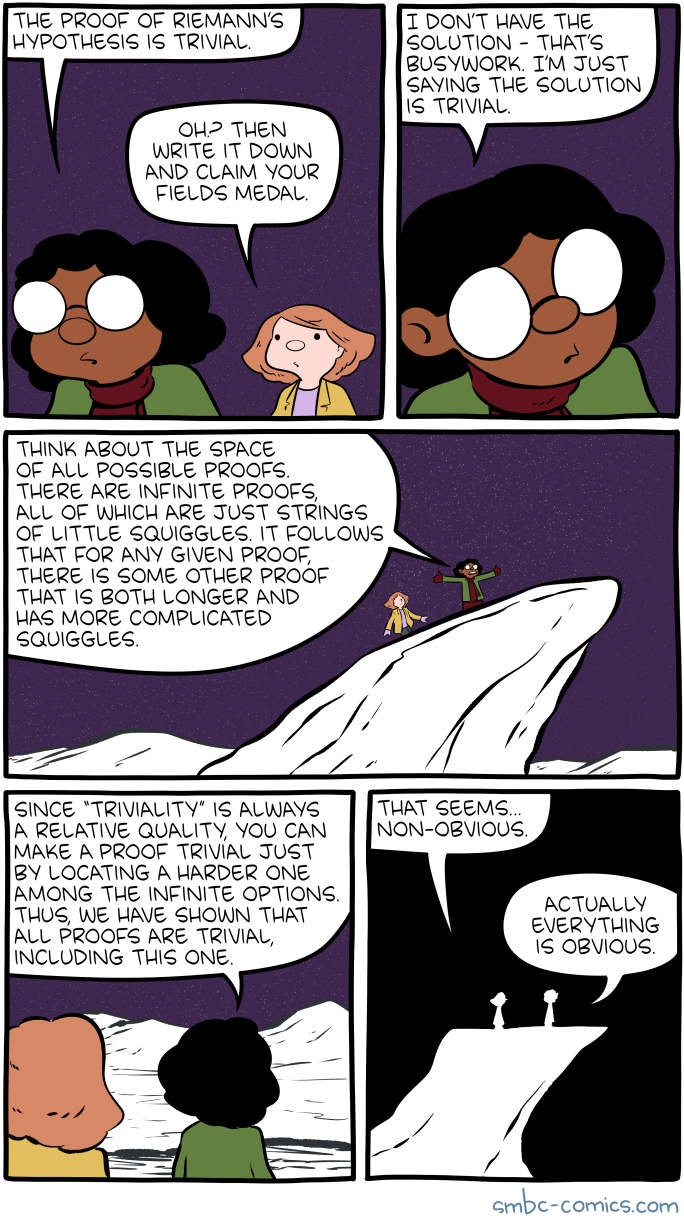
The comic features two mathematicians discussing the nature of mathematical proof. One observes that "the proof of Fermat's last theorem is trivial" -- but then clarifies this provocative claim. The argument goes: the proof of the remaining uniqueness of a solution is trivial, so just write it down and claim your Fields Medal. The other mathematician objects that she does not have the solution. The first then launches into a meta-mathematical argument: consider the space of all possible proofs. Some are finite strings of symbols. As long as it is logically coherent, there is some other proof that is both shorter and more complicated-looking. Since "triviality" is always relative, you can always make a proof trivial just by comparing it to something more convoluted -- including this very argument.
The punchline arrives when the second mathematician asks if this reasoning seems serious, and the first replies, "Actually, everything is trivial" -- a tongue-in-cheek claim that reduces all of mathematics to triviality through a kind of rhetorical sleight of hand.
The Humor
The humor plays on the way mathematicians use the word "trivial." In math culture, calling something "trivial" can mean it is genuinely simple, but it is also notoriously used to hand-wave away difficult steps ("the proof is left as a trivial exercise for the reader"). The comic takes this to its logical extreme by constructing a pseudo-philosophical argument that everything is trivial, satirizing how mathematicians sometimes dismiss complexity. The joke also pokes fun at the type of overly abstract reasoning that sounds impressive but is ultimately circular and unhelpful.
References
Fermat's Last Theorem, famously conjectured by Pierre de Fermat in 1637 and proved by Andrew Wiles in 1995, is referenced here as a canonical example of a theorem whose proof is anything but trivial -- Wiles's proof runs over 100 pages of highly advanced mathematics. The Fields Medal is the highest honor in mathematics, awarded every four years.