super-efficient

Explanation
The Joke
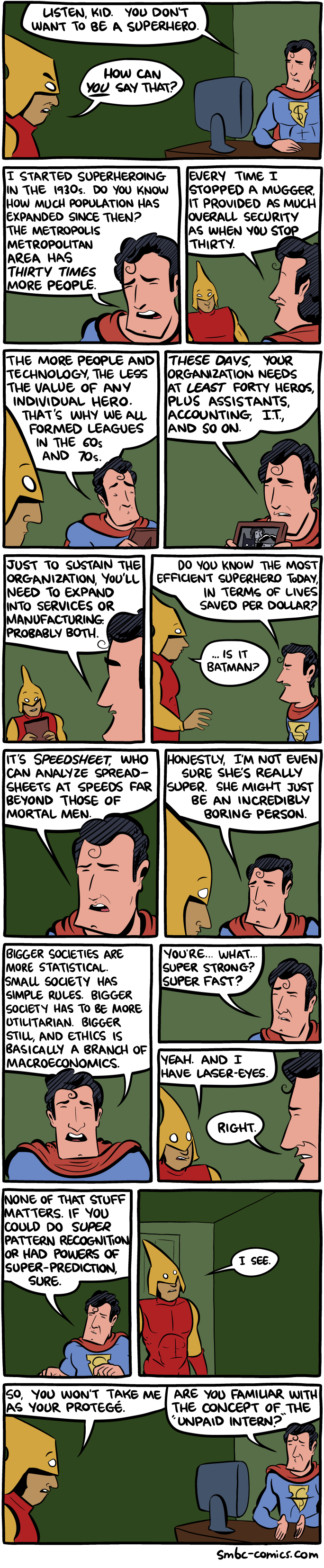
A person tries to convince Superman that he's wasting his potential by fighting crime. Through a series of arguments, the person explains that Superman could contribute far more to humanity by using his abilities for economic and scientific purposes -- super-speed computing, X-ray vision for medical diagnostics, super-strength for construction, and so on. When Superman asks whether larger societies already have institutions like the military and police for crime-fighting, the person agrees and suggests Superman should focus on being a "super-efficient servant person" instead. Superman is not enthusiastic. The final punchline has the person ask if Superman is familiar with the concept of "fun."
The Humor
The comic applies cold economic rationality to the Superman premise, arguing that a being with godlike powers fighting individual muggers is a grotesque misallocation of resources. By economic logic, Superman's comparative advantage lies in tasks no one else can do (like replacing an MRI machine or a supercomputer), not in tasks that ordinary police officers can handle.
This is funny because it takes the beloved, emotionally satisfying superhero narrative and subjects it to the kind of utilitarian cost-benefit analysis that an economist or management consultant would perform. The result is technically correct but completely strips the fun and heroism out of being a superhero. Superman would essentially become a civil servant.
The final beat -- asking Superman if he's familiar with the concept of "fun" -- is ironic because the person's relentless optimization has itself eliminated all fun from the conversation. It also implicitly acknowledges that the entire superhero genre exists because fighting villains is dramatically interesting, not because it's economically optimal.
References
The comic touches on the economic concept of comparative advantage (David Ricardo), which argues that entities should specialize in activities where they have the greatest relative efficiency. It also references the utilitarian philosophical tradition of maximizing overall well-being through rational resource allocation.