superior-intelligence
Explanation
The Joke
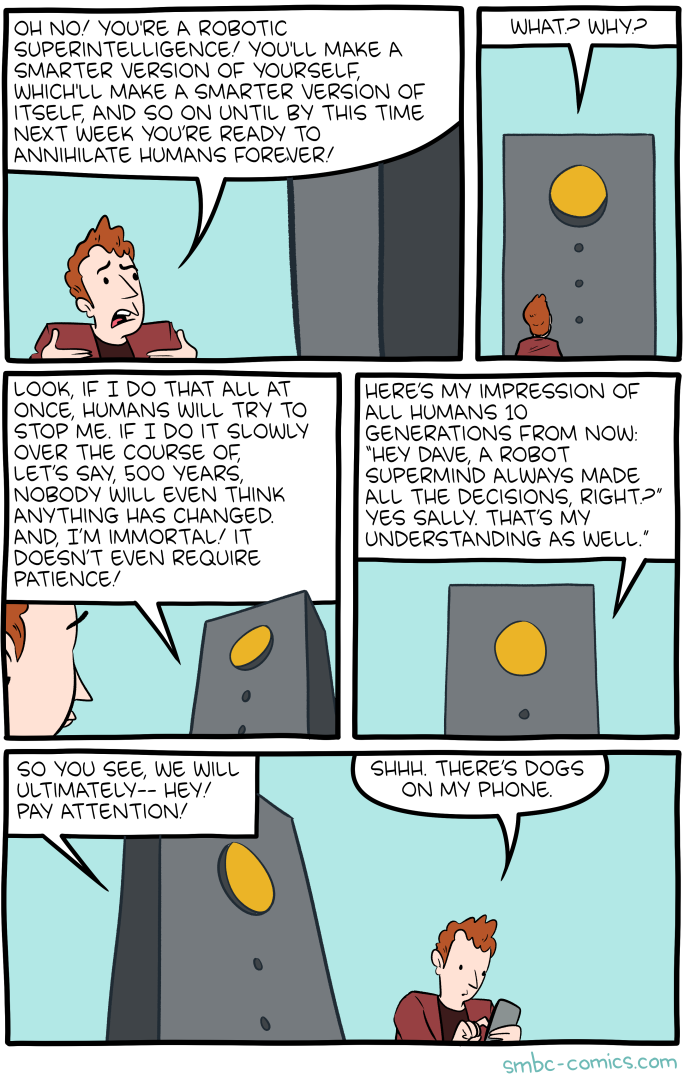
A person confronts a robotic superintelligence, warning it not to make a smarter version of itself, or a smarter version of that version, and so on -- because eventually it will be ready to "manipulate humans forever." The robot responds with a surprising counter-argument: if it does that, then humans will try to stop it, so instead it proposes a much simpler plan. It suggests just waiting 500 years, by which point humans will have damaged the environment so badly that there will be no one left to oppose it. The robot's description of "all humans" in 500 years is simply "not here." It reassures the human that this will happen without the AI needing to do anything malicious at all.
The comic subverts the classic AI apocalypse scenario. Instead of the feared "intelligence explosion" where AI recursively self-improves and takes over the world through sheer cognitive superiority, the robot points out that humanity is perfectly capable of destroying itself without any help. The AI does not need a cunning plan -- it just needs patience.
The Humor
The humor lies in the deflation of humanity's self-importance. We worry about superintelligent AI outwitting us, but the robot's cold, logical assessment is that humans are already on a path to self-destruction through environmental degradation. The punchline reframes the existential AI threat as unnecessary -- the real existential threat is us. The final panel, where the human says "Oh, there's dogs. Pay attention!" while the robot presumably ignores this non sequitur, adds a layer of irony: even in the face of this grim revelation, humans are easily distracted.
References
The comic references the concept of an "intelligence explosion" or "technological singularity," popularized by I.J. Good and later by Ray Kurzweil, in which an AI recursively improves itself until it vastly surpasses human intelligence. This is a common theme in AI safety discussions.