superluminal

Explanation
The Joke
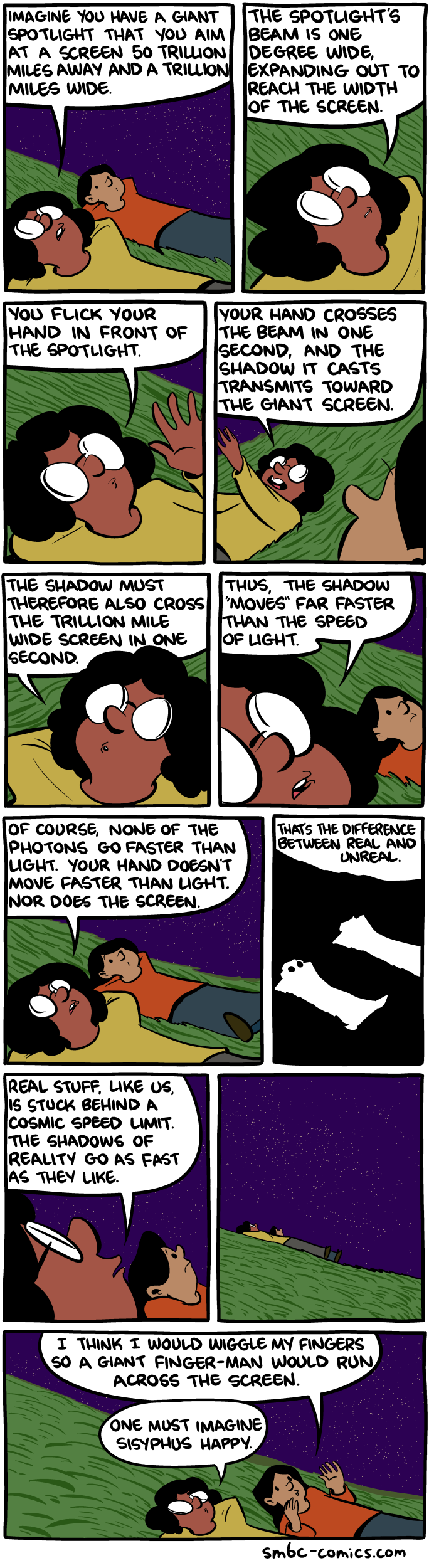
A character explains a thought experiment: imagine you have a giant spotlight aimed at a screen 50 trillion miles wide. You flick your hand in front of the spotlight, and in one second your hand crosses the beam. The shadow it casts on the giant screen must therefore also cross the screen in one second — meaning the shadow moves faster than the speed of light across the 50-trillion-mile-wide screen. The character then clarifies: of course, none of the "shadows" go faster than light. Your hand does not move faster than light, and neither does the screen. "Real stuff, like us, is stuck behind a cosmic speed limit." The shadows of reality can go as fast as they like. The character then says they would wiggle their fingers so a giant finger-man would run across the screen, adding: "One must imagine Sisyphus happy."
The Humor
The comic is a playful explanation of a real physics concept — that shadows and other "projections" are not physical objects and thus are not constrained by the speed of light. While nothing carrying information or matter can exceed light speed, a shadow sweeping across a distant surface can appear to move superluminally because it is not a single entity traveling — it is just the sequential absence of light at different points. The joke escalates from a genuine physics lesson into absurdist whimsy: the character wants to use this cosmic loophole to make a giant shadow puppet run across a screen spanning trillions of miles. The closing line, "One must imagine Sisyphus happy," is a reference to Albert Camus's famous essay on the absurd, where he concludes that we must imagine Sisyphus (condemned to eternally roll a boulder uphill) as happy despite the futility of his task. The juxtaposition of deep existential philosophy with silly shadow puppets is the comedic payoff.
References
- The thought experiment about superluminal shadows is a well-known illustration in physics education, demonstrating the difference between phase velocity and group velocity, and why the cosmic speed limit only applies to information and matter.
- "One must imagine Sisyphus happy" is the closing line of Albert Camus's 1942 essay The Myth of Sisyphus, a foundational text of absurdist philosophy.