supernatural-selection
Explanation
The Joke
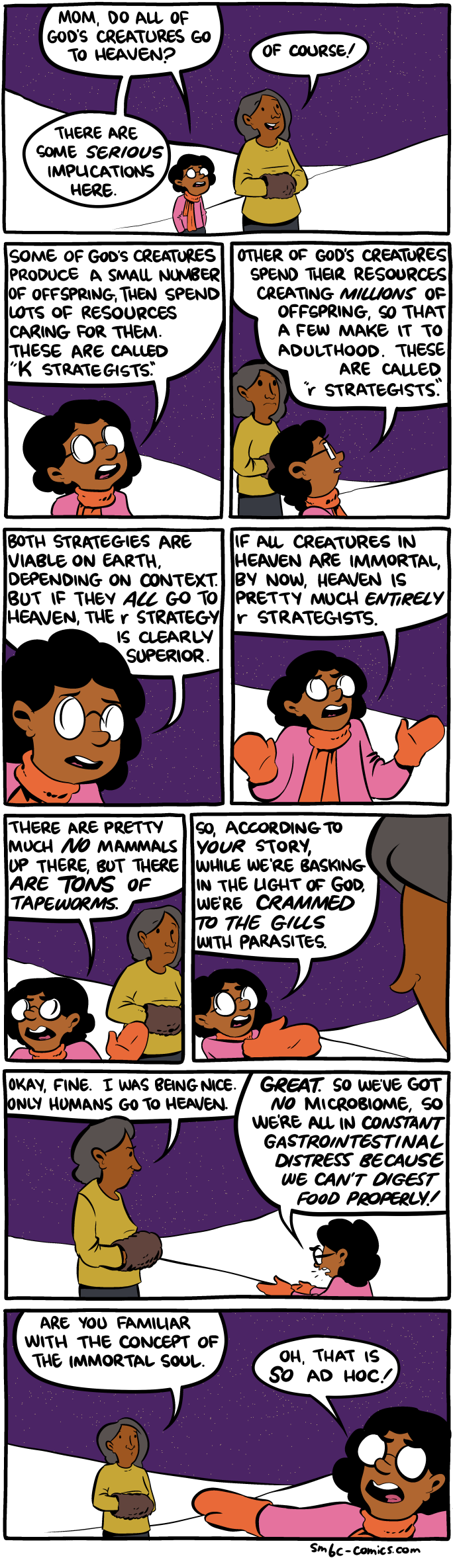
A child asks her mother: "Mom, do all of God's creatures go to heaven?" The mother says, "Of course!" The child then works through the implications. Some of God's creatures (K-strategists) produce few offspring and invest heavily in raising them, while others (r-strategists) produce huge numbers of offspring with minimal parental investment. Both strategies are viable on Earth, but if all creatures go to heaven and live there eternally, then by now heaven is "pretty much entirely" dominated by r-strategists — organisms like insects, parasites, and bacteria — because they have been producing vastly more offspring over billions of years. The child calculates that there are tons of "tardigrades" up there, and that since all creatures in heaven are immortal, they are "all in constant gastrointestinal distress because we can't digest food properly" (since the gut microbiome organisms are also immortal and cannot be killed). When the mother accuses the child of "trolling the concept of the immortal soul," the child responds: "Oh, that is SO ad hoc."
The Humor
The comic takes the comforting religious idea that "all God's creatures go to heaven" and applies rigorous ecological and evolutionary reasoning to it, producing horrifying results. The r/K selection theory distinction means that heaven would be overwhelmingly populated by insects, bacteria, and other prolific reproducers rather than by beloved pets and humans. The gastrointestinal distress detail is particularly clever — if gut bacteria are immortal in heaven, they can never be digested or expelled, causing eternal stomach problems. The child accusing the mother of making an "ad hoc" argument (a term from philosophy of science for a theory modification made solely to avoid a counterexample) is the cherry on top, treating a family conversation about faith as a formal academic debate.
References
- r/K selection theory describes two reproductive strategies: r-strategists produce many offspring with little investment (e.g., insects, fish), while K-strategists produce fewer offspring with greater parental investment (e.g., mammals).
- Tardigrades (water bears) are microscopic animals famous for their extreme resilience.
- Ad hoc reasoning, in philosophy of science, refers to adding arbitrary modifications to a theory solely to save it from falsification, rather than addressing the underlying problem.