sword-of-democracy
Explanation
The Joke
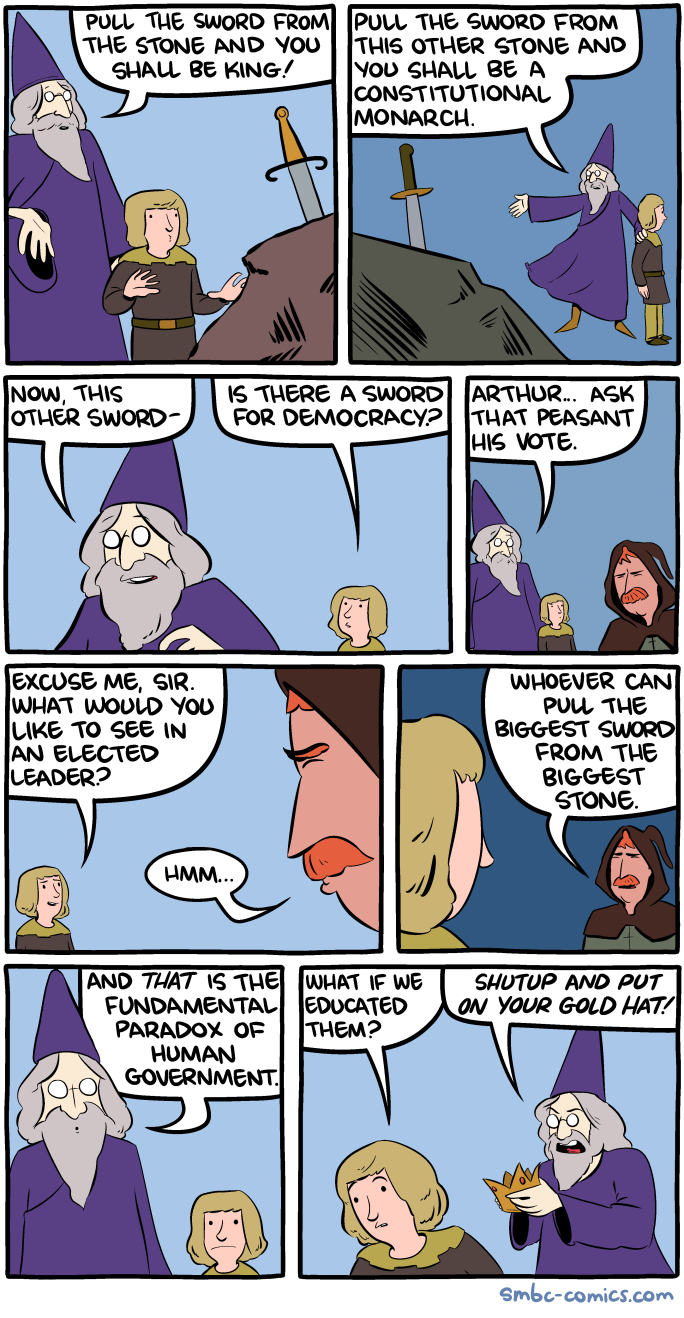
The comic opens with a classic Arthurian scene: a wizard (resembling Merlin) stands before two swords embedded in stones. He tells a knight that pulling one sword will make him king, while pulling the sword from the other stone will make him a "constitutional monarch." The knight asks about the second option, and the wizard explains further. The knight asks, "Is there a sword for democracy?" and the wizard replies, "Neither. Are you pregnant? We vote."
The knight then asks whether he would be an elected leader, and the wizard says, "Whoever can pull the sword from the binding stone." The knight raises the Tocqueville paradox of modern government, and the wizard's final response is simply: "Shut up and put on your gold hat." The comic progressively layers more and more modern political concepts onto the medieval sword-in-the-stone trope until the absurdity becomes overwhelming.
The Humor
The comic takes the inherently arbitrary and silly premise of the Arthurian "sword in the stone" legend -- that political legitimacy comes from pulling a weapon out of a rock -- and extends it by offering increasingly modern and sophisticated forms of government, all still determined by pulling swords from stones. The humor builds as each new political system is introduced but remains tied to the absurd sword-pulling mechanic. It is a satire of how all forms of political legitimacy, from divine right to democracy, rest on somewhat arbitrary foundations. The final "shut up and put on your gold hat" dismissal perfectly captures how political philosophy often gives way to pragmatic power.
References
The comic references the legend of King Arthur and the Sword in the Stone, a foundational myth of British monarchy. The "Tocqueville paradox" mentioned likely references Alexis de Tocqueville, the French political philosopher who wrote "Democracy in America" (1835) and analyzed the tensions and paradoxes inherent in democratic governance. The Monty Python film "Monty Python and the Holy Grail" (1975) famously parodied the idea that pulling a sword from a stone (or receiving one from a "watery tart") is no basis for a system of government -- a joke this comic extends further.