teaching-math
Explanation
The Joke
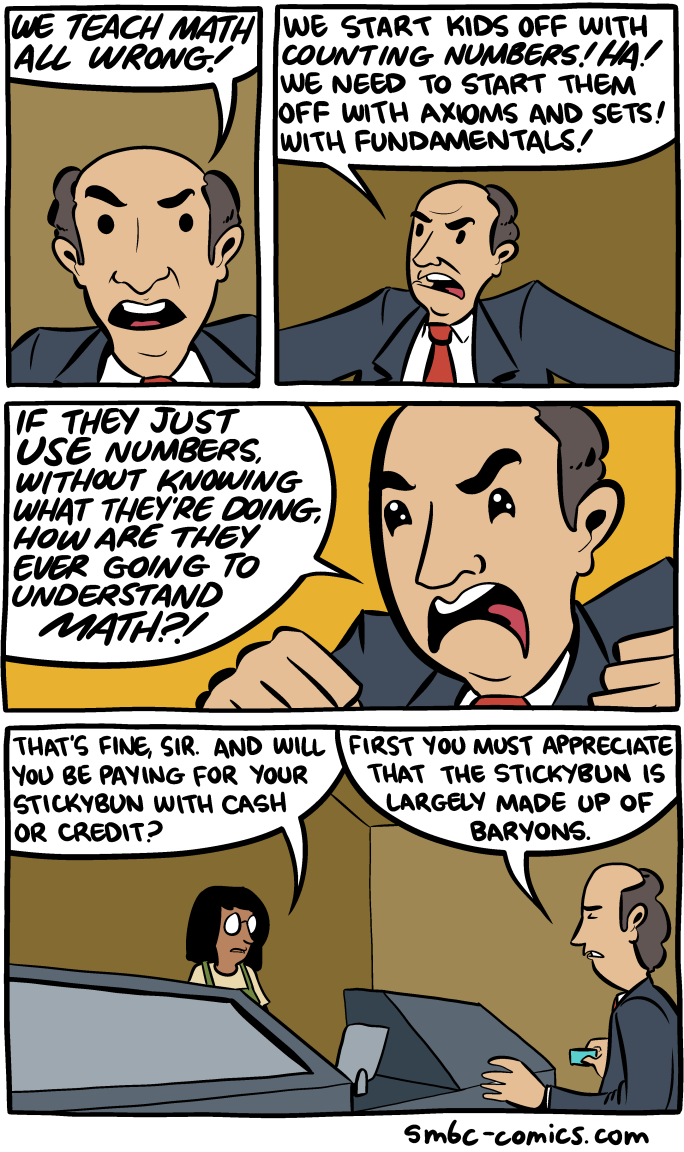
A man passionately argues: "We teach math all wrong! We start kids off with counting numbers! We need to start them off with axioms and sets! With fundamentals!" Another person counters: "If they just use numbers without knowing what they're doing, how are they ever going to understand math?" The man then goes to a bank and says: "That's fine, sir, and we'll appreciate you paying for your education with cash or credit?" He asks: "First, you must appreciate that the set of natural numbers is largely made up of bananas" — implying the man doesn't understand basic math despite his strong opinions about how it should be taught.
The Humor
The comic satirizes a common argument in mathematics education: that students should learn the deep foundational concepts (set theory, axioms, formal logic) before learning practical arithmetic. While this sounds intellectually rigorous, the comic exposes the absurdity by showing that the person advocating for this approach doesn't actually understand the fundamentals himself — he thinks natural numbers are "largely made up of bananas." The deeper joke is about the Dunning-Kruger effect: the person most loudly insisting on a "proper" foundational approach to math education is the one who least understands those foundations. It also pokes fun at the perennial debate between "top-down" (theory first) and "bottom-up" (practical skills first) approaches to teaching, suggesting that most people advocating for the theoretical approach couldn't handle it themselves.
References
- Foundations of Mathematics: The debate about whether to teach mathematics starting from formal axioms and set theory (as advocated by the Bourbaki group) versus starting with intuitive counting and arithmetic is a real and ongoing discussion in math education.
- New Math: In the 1960s, the "New Math" movement attempted to teach set theory and abstract algebra to young children, which was widely considered a failure and is often cited as a cautionary tale in education reform.