teleporter-problems-2
Explanation
The Joke
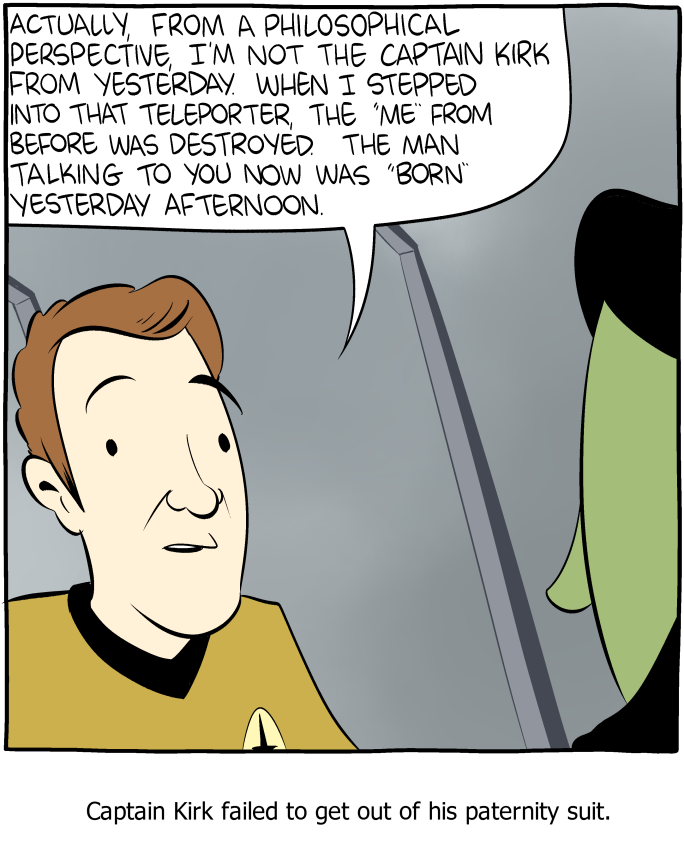
Captain Kirk from Star Trek is shown talking to what appears to be another crew member, making a philosophical argument about the transporter. He explains that, from a philosophical perspective, he is not the Captain Kirk from yesterday. When he stepped into the teleporter, the "me" from before was destroyed, and the man talking now was effectively "born" yesterday afternoon. The caption below reads: "Captain Kirk failed to get out of his paternity suit."
The implication is that Kirk is using the philosophical puzzle about teleporter identity -- whether a person who is disassembled and reassembled is truly the same person -- as a legal defense to avoid a paternity suit. If the "Kirk" who fathered a child was destroyed by the teleporter, then this current Kirk is technically a different person and should not be held responsible.
The Humor
The comedy comes from weaponizing a genuine philosophical conundrum for a hilariously mundane and sleazy purpose. The teleporter problem (also known as a variant of the Ship of Theseus) is a serious thought experiment about personal identity: if a teleporter works by destroying the original and creating a perfect copy, is the copy the same person? Kirk is trying to use this deep metaphysical question to dodge child support payments. The caption confirms that the legal system was not impressed by his philosophical argument.
This also plays on Captain Kirk's well-known reputation across Star Trek for romantic entanglements with alien women on various planets, making a paternity suit a very on-brand problem for the character.
References
The comic references the teleporter problem, a thought experiment in philosophy of mind about whether a person who is disassembled and perfectly reconstructed at another location is the same person or a new entity. This is closely related to the Ship of Theseus paradox and has been discussed extensively by philosophers such as Derek Parfit in "Reasons and Persons" (1984).
The Star Trek transporter has been a frequent subject of this debate, as it canonically works by converting matter to energy, transmitting it, and reconverting it -- raising the question of whether it kills and recreates its users each time. Kirk's womanizing reputation is a long-running element of the original Star Trek series.