the-arrow-of-time

Explanation
The Joke
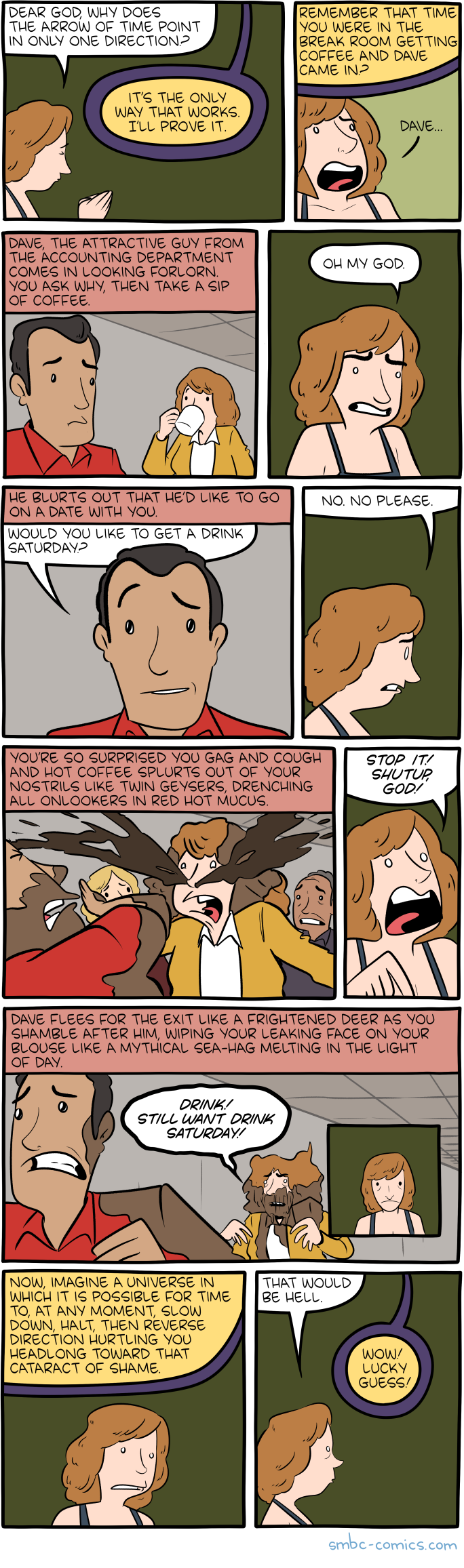
The comic opens with a narrator addressing God, complaining that "the arrow of time points in only one direction." This sets up a premise rooted in physics -- the thermodynamic arrow of time means we experience events sequentially and cannot revisit past moments. God's response is that this is "the only way that works," and to prove it, God shows what would happen if time could flow in both directions.
What follows is a sequence depicting the nightmare of a man trying to flirt with a woman at what appears to be a coffee shop, except every version of himself from different points in the timeline shows up simultaneously. His future self barges in looking for coffee, his various selves overlap and crowd the scene, and the woman is horrified as multiple instances of the same man pile up. One version begs for a drink, another comments on her nostrils, and eventually a future version reveals he has been writing her name on his body like a stalker. The woman is understandably screaming "STOP IT! DOCTOR! DOCTOR!" In the final panels, the man concedes that the arrow of time pointing one way is actually fine, and the woman -- having somehow still agreed to a date on Saturday -- remarks "how lucky" with obvious dread.
The Humor
The joke takes the abstract physics concept of time's arrow and grounds it in the most relatable possible scenario: the awkwardness of courtship. The comic argues that if all moments of a relationship existed simultaneously, the cumulative effect of every desperate, cringeworthy, and obsessive thing a person does over time would be visible all at once -- and it would be absolutely horrifying. The comedy escalates with each panel as the situation gets worse, from mildly awkward to genuinely unhinged. The punchline lands on the idea that the arrow of time is not some cosmic limitation but actually a mercy -- it lets us spread our worst behavior out over time so no one has to witness it all at once.
References
- The arrow of time: a concept from thermodynamics (associated with the second law and entropy) describing why we perceive time as flowing in one direction. The phrase was coined by British astronomer Arthur Eddington in 1927.