the-demon
Explanation
The Joke
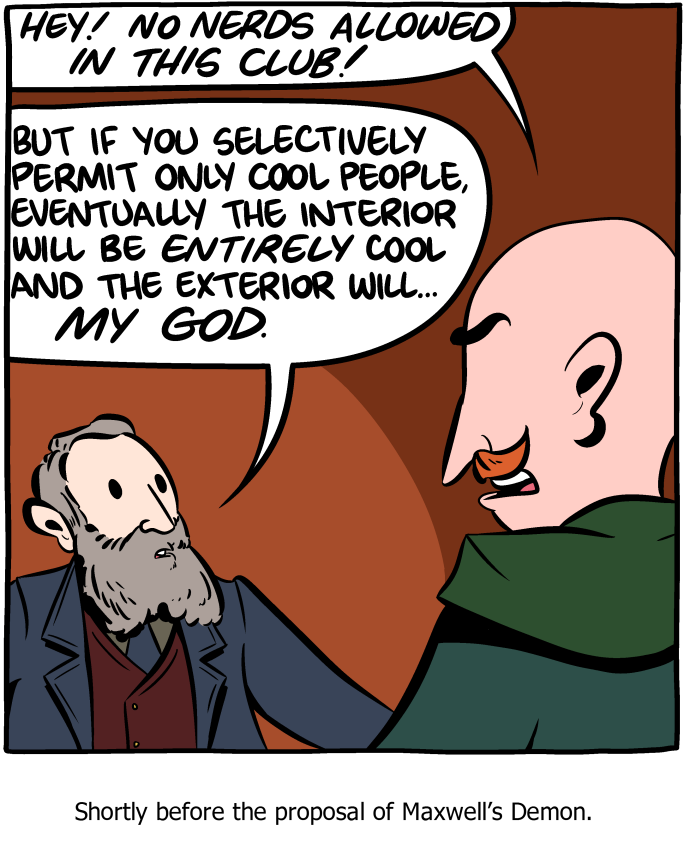
A bouncer at a club declares "Hey! No nerds allowed in this club!" A man who appears to be James Clerk Maxwell (depicted with his characteristic beard) responds by pointing out that if you selectively permit only cool people, eventually the interior will be entirely cool and the exterior will... at which point he trails off with "My God."
The bouncer has inadvertently described the concept of Maxwell's Demon -- a famous thought experiment in thermodynamics. The caption reads: "Shortly before the proposal of Maxwell's Demon."
The Humor
The comic plays on a double meaning of "cool." Maxwell's Demon is a thought experiment proposed by physicist James Clerk Maxwell in 1867, in which a hypothetical tiny being (the "demon") sits at a gate between two chambers of gas and selectively allows only fast-moving (hot) molecules to pass one way and slow-moving (cold) molecules to pass the other way, seemingly violating the second law of thermodynamics.
The bouncer at the club is performing exactly the same function -- selectively sorting people at a barrier based on a criterion ("coolness") -- which makes Maxwell realize the physics analogy. The word "cool" works both as slang for socially desirable and as a reference to temperature (cold/slow molecules), tying the social scenario directly to the thermodynamic thought experiment.
The humor also comes from the idea that a mundane social situation (a bouncer at a club) could inspire a major breakthrough in theoretical physics.
References
- Maxwell's Demon: A thought experiment proposed by James Clerk Maxwell in 1867. It imagines a being that can sort fast and slow gas molecules between two chambers, seemingly decreasing entropy without expending energy. It was a key puzzle in thermodynamics until information theory (Landauer's principle) resolved the paradox by showing that erasing the demon's memory of each molecule's speed necessarily generates entropy.
- James Clerk Maxwell (1831-1879): Scottish physicist best known for formulating the classical theory of electromagnetic radiation (Maxwell's equations) and his contributions to statistical mechanics and thermodynamics.