the-denial-of-death
Explanation
The Joke
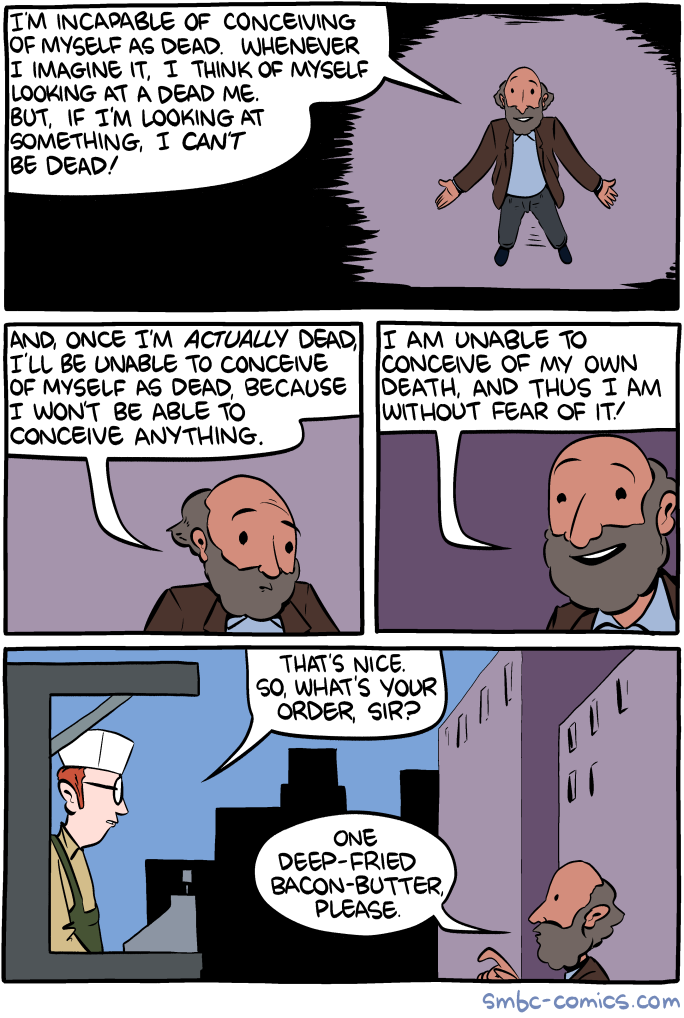
A man is reflecting on the nature of death, articulating a philosophical argument. He says he is incapable of conceiving of himself as dead -- whenever he imagines it, he thinks of himself looking at a dead version of himself, but since he is looking at something, he cannot truly be dead. He continues: since once he is actually dead, he will be unable to conceive of anything (because the dead do not have consciousness), he will not be able to conceive of anything at all.
He then concludes with a second insight: his inability to conceive of his own death means he is unable to fear it. Since he cannot imagine what it is like to be dead, he can live without fear of death. The other person (who appears to be working at a food counter) responds flatly, "That is nice. So what is your order?" The philosopher orders a deep-fried moon platter -- bringing the entire existential meditation crashing back down to the mundane reality of ordering fast food.
The Humor
The comic plays on the classic SMBC trope of someone launching into a deep philosophical soliloquy in a completely inappropriate context -- in this case, at what appears to be a fast food counter. The dramatic existential reasoning about the impossibility of conceiving one is own death is undercut by the bored service worker who just wants to take the order. The absurd contrast between the gravity of the topic (mortality and consciousness) and the triviality of the setting (ordering a deep-fried moon platter) is the core of the humor.
References
The title "The Denial of Death" references Ernest Becker is 1973 Pulitzer Prize-winning book of the same name, which argues that much of human behavior and culture is motivated by an unconscious denial of mortality. The philosophical argument in the comic echoes ideas from Epicurus, who argued that death should not be feared because "when we exist, death is not; and when death exists, we are not." The idea that one cannot conceive of one is own non-existence is also discussed by Freud, who wrote that the unconscious mind is incapable of imagining its own death.