The Erotic Turing Test

Explanation
The Joke
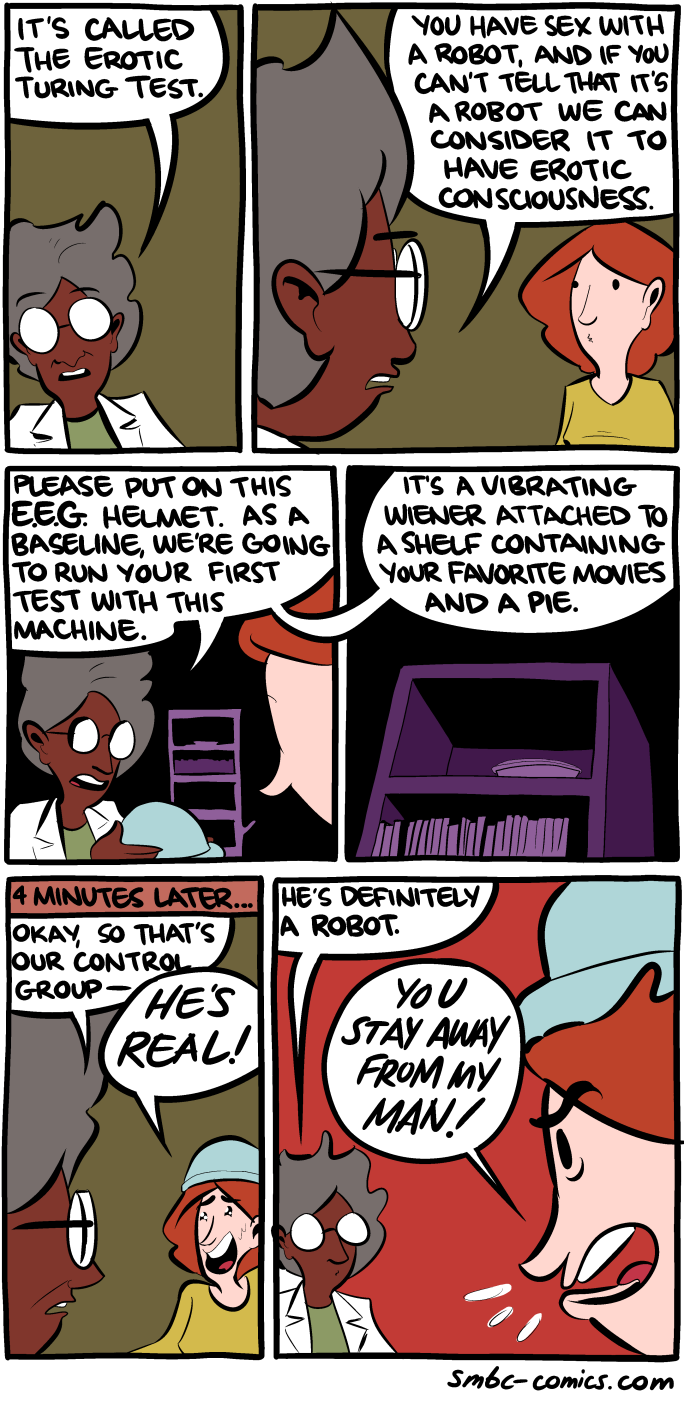
A researcher explains the concept of an "Erotic Turing Test" -- if you have sex with a robot and you can't tell that it's a robot, you can consider it to have "erotic consciousness." She then asks the test subject to put on a blindfold (a "BBC helmet" as a baseline) while they run his first test with "this machine." The machine turns out to be a vibrating armchair attached to a shelf containing his favorite movies and a pie. Five minutes later, the subject declares it's "definitely a robot" but tells his girlfriend to stay away -- he has clearly fallen in love with the machine regardless.
The Humor
The comedy works on multiple levels. First, there is the absurdity of formalizing an "Erotic Turing Test" as an academic concept, applying the rigorous framework of the original Turing Test (designed to evaluate machine intelligence) to something as base as sexual satisfaction. Second, the punchline subverts expectations: the "robot" is not a humanoid sex machine but simply a vibrating chair with comfort items (movies and pie). The test subject immediately identifies that it is not human, yet still prefers it to his actual girlfriend -- suggesting that what people really want from a partner is not sophisticated human connection but simple creature comforts. The girlfriend's outrage at being rejected in favor of a vibrating chair with snacks adds to the comedic deflation.
References
The Turing Test is a measure of machine intelligence proposed by Alan Turing in 1950, in which a human evaluator judges whether they are conversing with a human or a machine. The comic applies this framework to physical intimacy rather than conversation.