the-ethical-fourier-transform
Explanation
The Joke
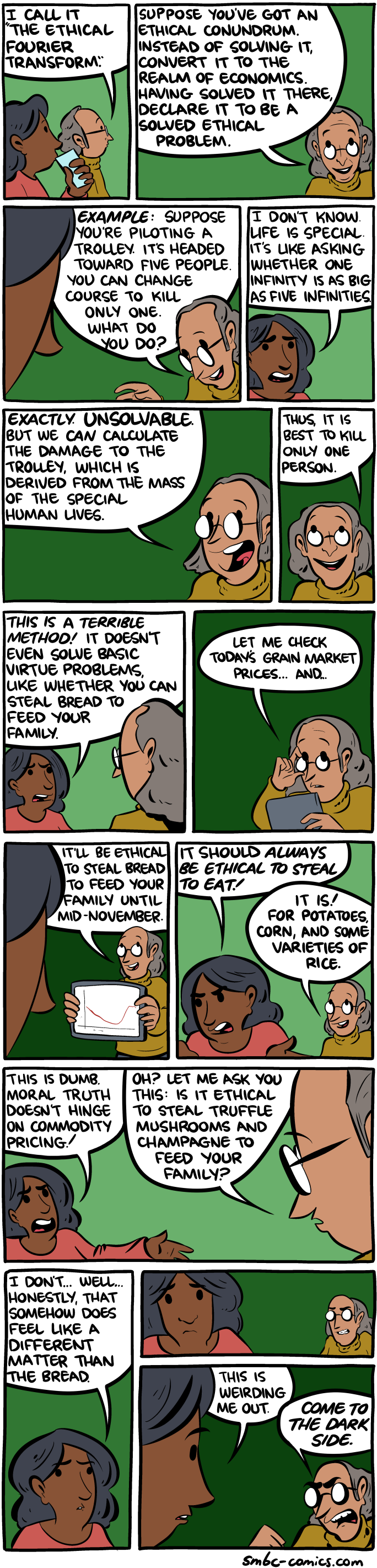
A woman presents her invention: the Ethical Fourier Transform. She explains that just as a mathematical Fourier transform decomposes a complex signal into simple component waves, her ethical version decomposes any complex moral problem into simpler ethical problems. She demonstrates with the trolley problem: instead of deciding whether to divert a trolley to kill one person instead of five, she decomposes it into component ethical questions -- the damage to the trolley, the value derived from the mine where the trolley materials came from, and so on.
Her colleague objects that this is a terrible method -- it does not actually solve hard ethical problems but just replaces them with many smaller ones, like whether it is ethical to steal bread to feed your family. The inventor counters that these simpler problems are solvable: it would always be ethical to steal bread to eat. This leads to an escalating series of increasingly specific questions ("Is it ethical to steal truffle oil?", "What about corn, and some very nice rice?") that reveals the method does not simplify anything -- it just generates an infinite regress of smaller but still contentious moral questions. Eventually her colleague gives up and tells her to come to the other side of the door, implying she is in some kind of institution.
The Humor
The comic satirizes the tendency in philosophy (and particularly in applied ethics) to try to resolve difficult moral dilemmas by breaking them into components, only to find that the components are themselves contentious. The "Ethical Fourier Transform" sounds impressively mathematical and rigorous, but in practice it just transforms one hard question into many hard questions -- the opposite of a useful simplification. The escalating food theft examples (from bread to truffle oil to corn with nice rice) perfectly illustrate how even the "simple" component problems resist easy answers. The final panel implies the inventor may be delusional or institutionalized, adding a layer of dark humor to the entire exercise.
References
- The Fourier Transform is a mathematical operation that decomposes a function (often a signal) into its constituent frequencies. It is fundamental to signal processing, physics, and engineering. Named after Joseph Fourier (1768-1830).
- The Trolley Problem is a famous thought experiment in ethics, first introduced by Philippa Foot in 1967 and later developed by Judith Jarvis Thomson. It asks whether it is morally permissible to divert a runaway trolley to kill one person in order to save five.
- The question of whether it is ethical to steal bread to feed your family is a classic moral dilemma, famously explored in Victor Hugo's Les Miserables through the character of Jean Valjean.