The Five Paragraph Method
Explanation
The Joke
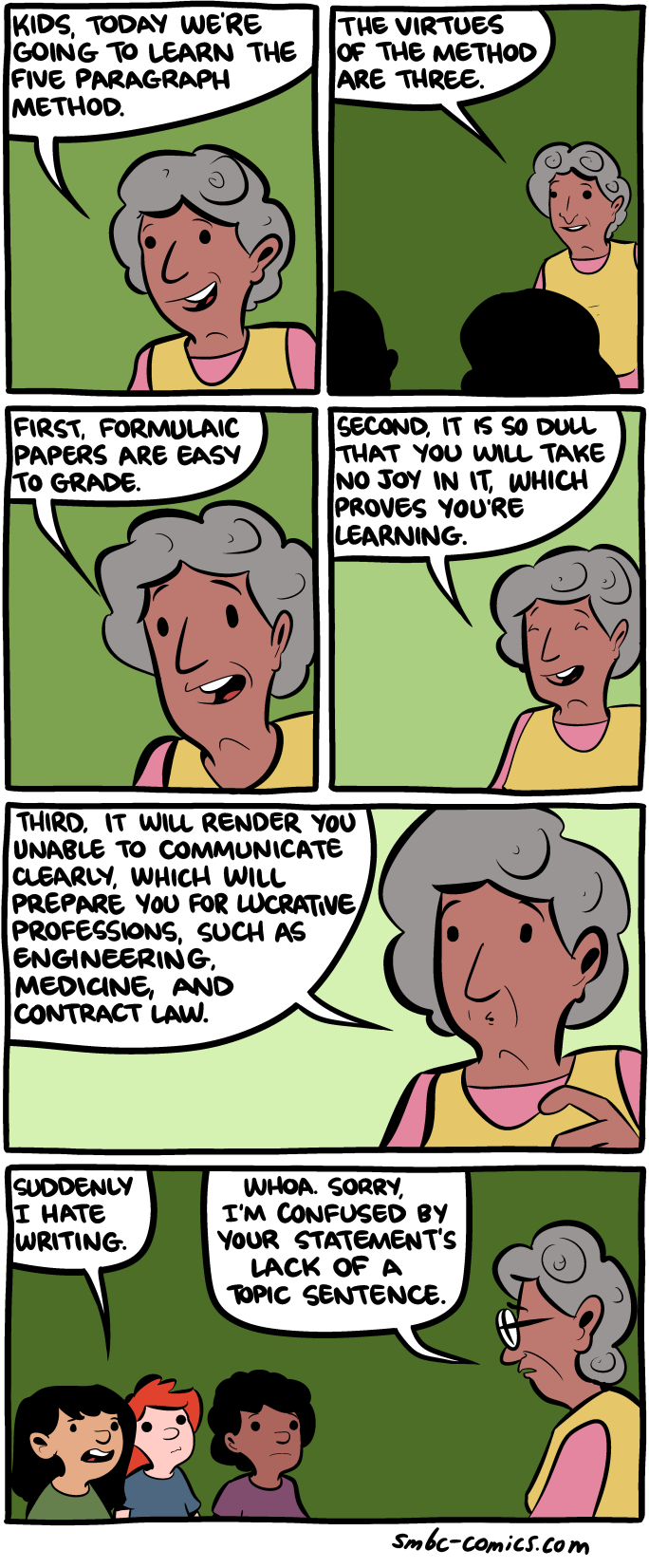
A teacher introduces the five-paragraph essay method to her students, listing its "virtues." However, instead of praising it, she delivers a devastating critique disguised as a lesson:
- "Formulaic papers are easy to grade" (it benefits teachers, not students).
- "It is so dull that you will take no joy in it, which proves you are learning" (conflating boredom with education).
- "It will render you unable to communicate clearly, which will prepare you for lucrative professions such as lawyering, pharmaceuticals, medicine, and contract law" (obfuscation is a professional skill).
A student responds: "Coooool, I hate writing." Another student then says: "Haha, sorry, I'm confused by your statement's lack of a topic sentence" -- already having internalized the rigid format to the point where normal conversation seems wrong.
The Humor
The comic is a sharp satire of the five-paragraph essay format (introduction, three body paragraphs, conclusion), which is widely taught in American schools and widely criticized by writing instructors at the college level. The teacher's "virtues" are actually damning indictments: the format exists because it is easy to grade at scale, it kills any joy in writing, and it teaches students to write in a stilted, formulaic way that is only useful in professions where unclear communication is actually advantageous (legal contracts, pharmaceutical disclaimers, etc.).
The final panel delivers the punchline in two ways: one student enthusiastically embracing the method precisely because it removes creative engagement, and another student who has already been so conditioned by formulaic structure that they cannot parse a normal conversational statement that lacks a topic sentence. This second student demonstrates that the damage is already done -- the format has overwritten their ability to engage with natural language.
References
The five-paragraph essay (also called the "hamburger essay" or "three-prong thesis" essay) is a standard writing format taught in American middle and high schools. It has been criticized by composition scholars such as John Warner ("Why They Can't Write") for producing formulaic, lifeless prose and failing to prepare students for real-world writing tasks. The comic echoes these criticisms while adding the sardonic observation that bad writing skills are actually rewarded in certain lucrative professions.