the-five-stages

Explanation
The Joke
The comic is titled "The Five Stages of Learning About the Kubler-Ross Model" and maps the famous "five stages of grief" onto the experience of actually learning about the model itself:
- Denial: "What? No, nobody would seriously propose that grief comes in distinct stages."
- Anger: "It's just something they made up and they even say in the original book that it's arbitrary and incomplete!"
- Bargaining: "Okay, but if we say it's literature and not science, then it's an interesting perspective."
- Depression: "People are treating this model like it's a biological fact."
- Acceptance: "Egh, it's not even in the top 100 worst psych theories of the sixties."
The Humor
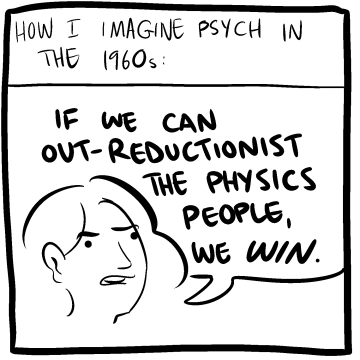
The comic is brilliantly self-referential. It uses the Kubler-Ross model's own structure (the five stages of grief) to critique the Kubler-Ross model itself. Each "stage" the person goes through mirrors their emotional journey of discovering that this widely-cited psychological framework is not actually well-supported by scientific evidence. The stages progress from disbelief that anyone would propose such a simplistic model, through anger at its misuse, to a resigned acceptance that at least it is not the worst psychological theory from the 1960s -- an era that produced many questionable theories. The comic works as both a joke and genuine scientific commentary: the Kubler-Ross model has indeed been widely criticized by researchers for lacking empirical support, yet it remains one of the most popularly cited frameworks in psychology.
References
- The Kubler-Ross model (or "five stages of grief") was introduced by psychiatrist Elisabeth Kubler-Ross in her 1969 book On Death and Dying. The stages are: denial, anger, bargaining, depression, and acceptance.
- The model has been extensively criticized by psychologists and grief researchers for not being supported by empirical evidence, and Kubler-Ross herself acknowledged that the stages are not necessarily linear or universal.
- The reference to "worst psych theories of the sixties" alludes to the fact that the 1960s produced numerous psychological theories that have since been debunked or heavily revised.