the-fox-and-the-hedgehog
Explanation
The Joke
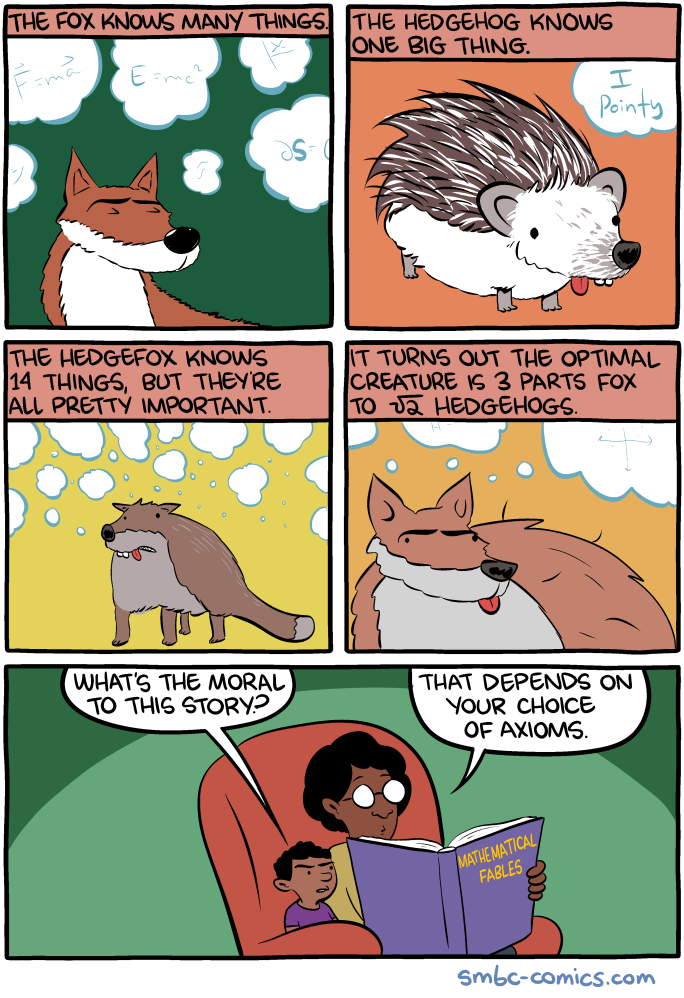
The comic riffs on the famous essay by Isaiah Berlin, "The Hedgehog and the Fox," which classifies thinkers into two categories: foxes, who know many things, and hedgehogs, who know one big thing. In the first two panels, a fox declares "The fox knows many things" while a hedgehog says "The hedgehog knows one big thing." This sets up the classical dichotomy.
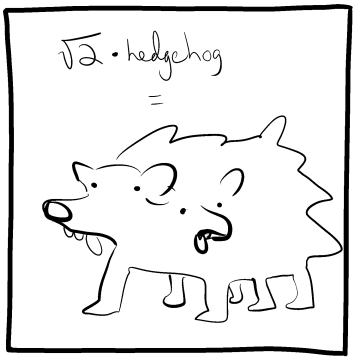
In the next panels, the hedgehog clarifies that it knows 14 things, but they are all pretty important. The hedgehog then works out that the optimal creature is 5 parts fox to 45 hedgehogs, turning a philosophical metaphor into a bizarre optimization problem. A child reading this story with a parent asks "What's the moral of this story?" and the fox answers "That depends on your choice of axioms" -- turning even the moral of the fable into a matter of mathematical or logical foundations.
The Humor
The humor comes from taking a literary and philosophical metaphor -- one meant to describe different styles of thinking -- and treating it with absurd mathematical literalness. Instead of the hedgehog and fox representing archetypes, they become data points in an optimization function. The final punchline about axioms is a joke about how mathematicians and logicians can never give a simple answer because everything depends on your starting assumptions, making even a children's fable unsatisfying.
References
The comic references Isaiah Berlin's 1953 essay "The Hedgehog and the Fox," which itself references a fragment attributed to the ancient Greek poet Archilochus: "The fox knows many things, but the hedgehog knows one big thing." Berlin used this to classify writers and thinkers like Tolstoy, Plato, and Aristotle.