the-fundamental-equation
.png)
Explanation
The Joke
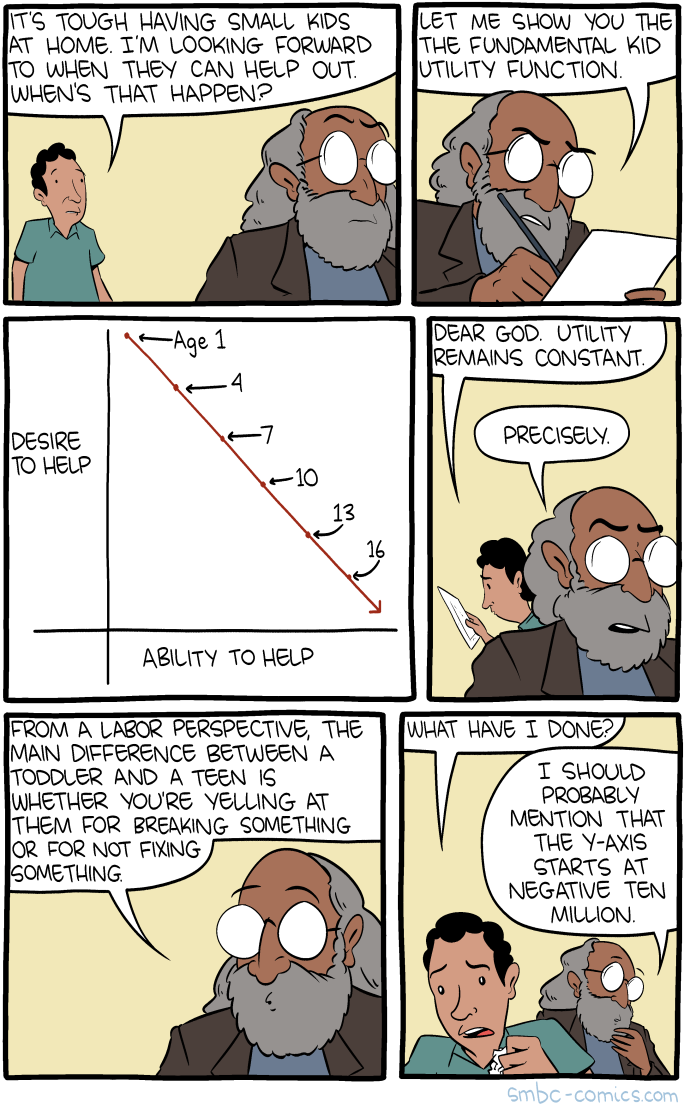
A parent excitedly tells a friend: "It''s tough having small kids, but I''m looking forward to when they can help out. Imagine that happening!" A cynical older man then presents a graph he calls "the fundamental equation" -- a utility function showing the relationship between a child''s "desire to help" and "ability to help" as they age. The graph shows an inverse relationship: when children are young, they have enormous desire to help but essentially zero ability. As they age and gain ability, their desire to help plummets proportionally. The "year-over-year utility remains constant" -- meaning the net usefulness of a child''s help never actually improves.
The older man labels this as a "precise" model, calling it "a proof, in principle" that the main difference between a toddler and a college student is whether you''re yelling at them for breaking things while trying to help, or yelling at them for not helping at all. In the final panel, the parent realizes: "Wait, I don''t think I codified... I should mention that this graph starts at negative and stays at negative."
The Humor
The comic hilariously captures a universal parenting experience: toddlers who desperately want to "help" with everything (making enormous messes in the process) and teenagers who are perfectly capable of helping but refuse to lift a finger. By framing this observation as a formal mathematical equation with a graph, the comic gives scientific gravitas to what every parent already knows -- that children are never useful at any age.
The graph itself is the core gag, showing the perfectly inverse relationship between desire and ability as a declining line. The "utility remains constant" punchline is the mathematical way of saying "it never gets better." The final panel twists the knife further by noting the constant utility isn''t even zero -- it''s negative, meaning children actively make things worse at every stage, just in different ways.
References
The comic parodies the style of economic utility functions and mathematical modeling. The graph resembles a standard supply-and-demand or trade-off curve from economics, applied here to the decidedly non-economic domain of parenting. The term "utility function" comes from economics and decision theory, where it represents a mathematical function that assigns a value to outcomes based on preferences.