the-importance-of-education
Explanation
The Joke
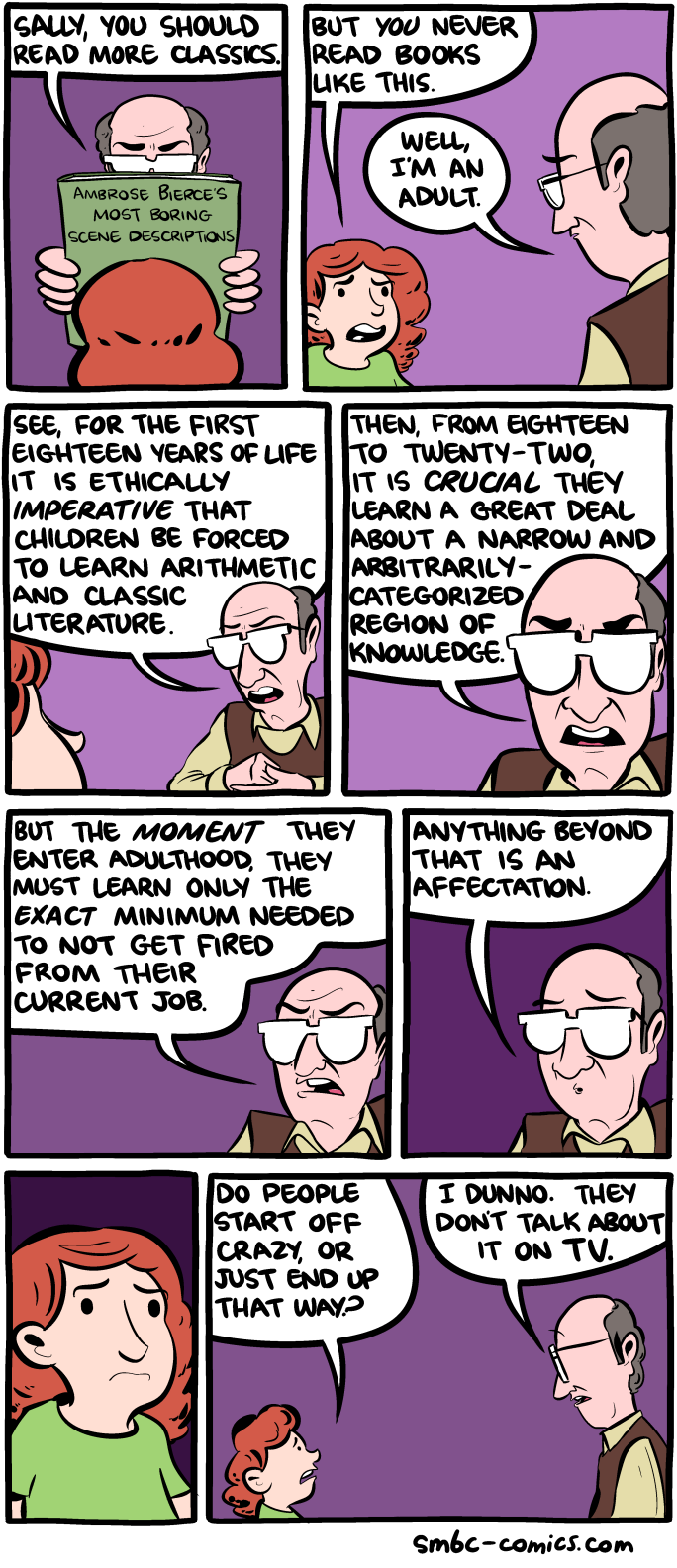
The comic follows a conversation between two people about education. A bald man in glasses tells a younger woman: "Cally, you should read more classics." She responds: "But you never read books like this" -- holding up a book with hearts on the cover (suggesting romance or light fiction). He huffily replies: "I am an adult."
The comic then follows his logic through life stages: "Gee, for the first eighteen years of life it is ethically imperative that children be forced to learn arithmetic and classic literature." Then: "From eighteen to twenty-two, it is crucial they learn a great deal about a narrow and arbitrarily-categorized region of knowledge." But: "The moment they enter adulthood, they just learn the exact minimum needed to not get fired from their current job." The final panel asks: "Do people start off crazy or just end up that way?" and someone responds: "I dunno, they don't talk about it on TV."
The Humor
The comic satirizes the strange discontinuity in how society treats education across different life stages. During childhood, education is treated as a sacred moral imperative -- children must be forced to learn the classics and mathematics. During college, intensive study of specialized knowledge is seen as essential. But the moment someone enters the workforce, all intellectual curiosity apparently evaporates, and people only learn the bare minimum to keep their jobs. The humor comes from pointing out this hypocrisy: the same adults who insist children must read classic literature do not themselves continue to pursue broad learning. The man who lectures "Cally" about reading classics is himself embodying this contradiction. The final punchline -- that nobody discusses this paradox because it is not on TV -- is an additional jab at adult intellectual passivity.
References
- The comic touches on the concept of lifelong learning and the well-documented decline in reading habits among adults after formal education ends.
- The phrase "arbitrarily-categorized region of knowledge" refers to academic majors and the somewhat arbitrary way universities divide knowledge into departments and disciplines.