the-largest-number-2
Explanation
The Joke
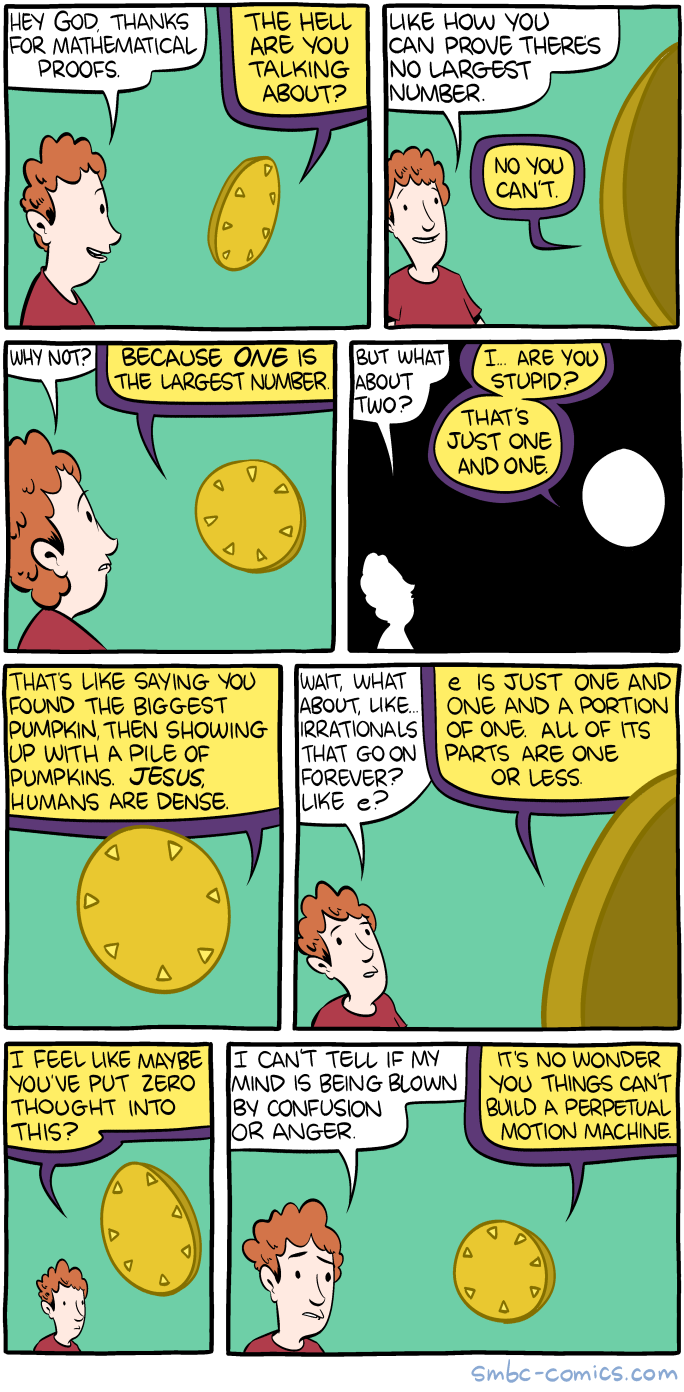
A person excitedly tells a coin-like character that they have found mathematical proofs that there is no largest number. The coin responds dismissively: "The hell are you talking about? Like how you can prove there is no largest number? You can't." The person asks why not, and the coin asserts: "Because one is the largest number."
The person is baffled: "Are you serious? That's just one. And one." The coin retorts that saying "you found the biggest number" is like showing up with a pile of hydrogen and saying humans are dense. The coin's argument is that everything is just "one and one and a portion of one" — that fractions are parts of one, and all larger numbers are just multiples of one.
By the end, the person feels like they have been put in zero, and the coin says: "If zero is real, my hand is being blown by the winds of anger." The person realizes: "No wonder you things can't fund a perpetual motion machine."
The Humor
The comic features a sentient coin who has an absurdly stubborn philosophical position: that "one" is the largest number because all other numbers are just combinations of ones. This is technically not wrong in a very narrow sense — all positive integers can be expressed as sums of ones — but it completely misses the point of what "largest" means. The coin is committing a classic logical fallacy of redefining terms to suit its argument.
The humor comes from the coin's unshakeable confidence in its wrong position and its increasingly aggressive rhetorical tactics. The hydrogen analogy (saying humans are "dense" by showing up with hydrogen, the lightest element) is the coin attempting to sound clever while making a deeply flawed comparison. The final exchange about perpetual motion machines is a parting shot suggesting the coin's species is bad at physics precisely because they reason this poorly.
References
The comic touches on concepts from number theory and the philosophy of mathematics. The idea that there is no largest number is a fundamental property of the natural numbers — for any number n, n+1 is larger. The comic also references perpetual motion machines, which are impossible under the laws of thermodynamics, suggesting the coin's civilization has poor scientific reasoning. The hydrogen joke references the fact that hydrogen is the lightest and simplest element, making it an ironic choice if you wanted to demonstrate "density."