the-most-american-movie

Explanation
The Joke
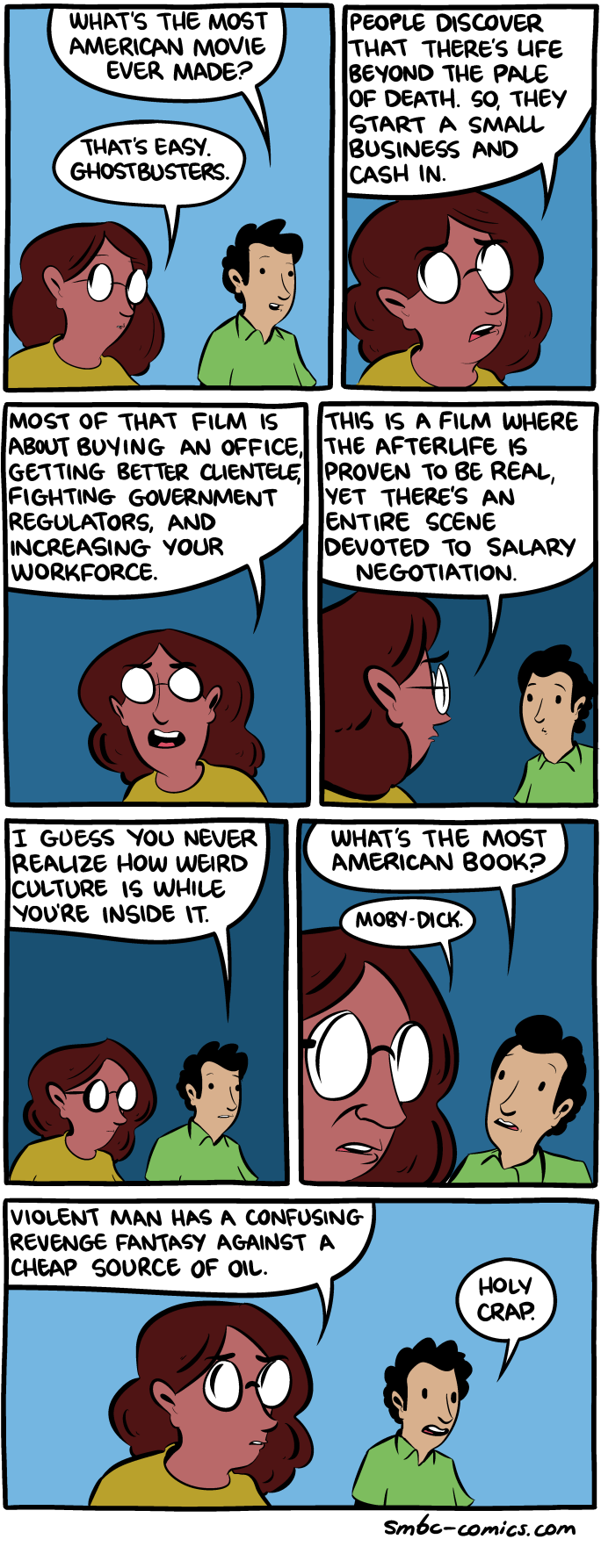
Two people discuss what the most American movie ever made is. One says "Ghostbusters," and explains: people discover there is life beyond the pale of death, so they start a small business and cash in. Most of the film is about buying an office, getting better qualified, fighting government regulators, and increasing your workforce. "This is a film where the afterlife is proven to be real, yet there is an entire scene devoted to salary negotiation." When told "I guess you never realize how weird American culture is while you're inside it," the conversation shifts to: "What's the most American book?" The answer: "Moby-Dick. A violent man has a confusing revenge fantasy against a cheap source of oil."
The Humor
The comic finds humor in reframing beloved American cultural works through a lens that exposes distinctly American cultural values. Ghostbusters, typically seen as a fun supernatural comedy, is reinterpreted as a story fundamentally about entrepreneurship, small business, deregulation, and capitalism -- even in the face of proof that the afterlife exists. The observation that the characters prioritize salary negotiation over the metaphysical implications of ghosts being real is both accurate and absurd.
The Moby-Dick punchline escalates the joke further by reducing Herman Melville's classic novel to its most cynically American elements: violence and obsession with oil (whale oil, in the novel's case). Captain Ahab's monomaniacal pursuit of the white whale becomes a "confusing revenge fantasy against a cheap source of oil," which also reads as a sly commentary on American foreign policy and oil politics.
References
- Ghostbusters (1984) is an iconic American comedy film in which a group of scientists start a ghost-catching business in New York City. The comic's observations about its plot are largely accurate -- the film does include scenes about buying their headquarters, negotiating with the EPA, and discussing pay.
- Moby-Dick (1851) by Herman Melville is widely considered one of the greatest American novels. It follows Captain Ahab's obsessive quest to kill the white whale that took his leg. Whale oil was a major industry in 19th-century America.
- The comic touches on the cultural observation that American stories often center entrepreneurship and capitalism even in genres (supernatural, literary epic) where other cultures might focus on philosophical or spiritual themes.