the-multiverse-explained
Explanation
The Joke
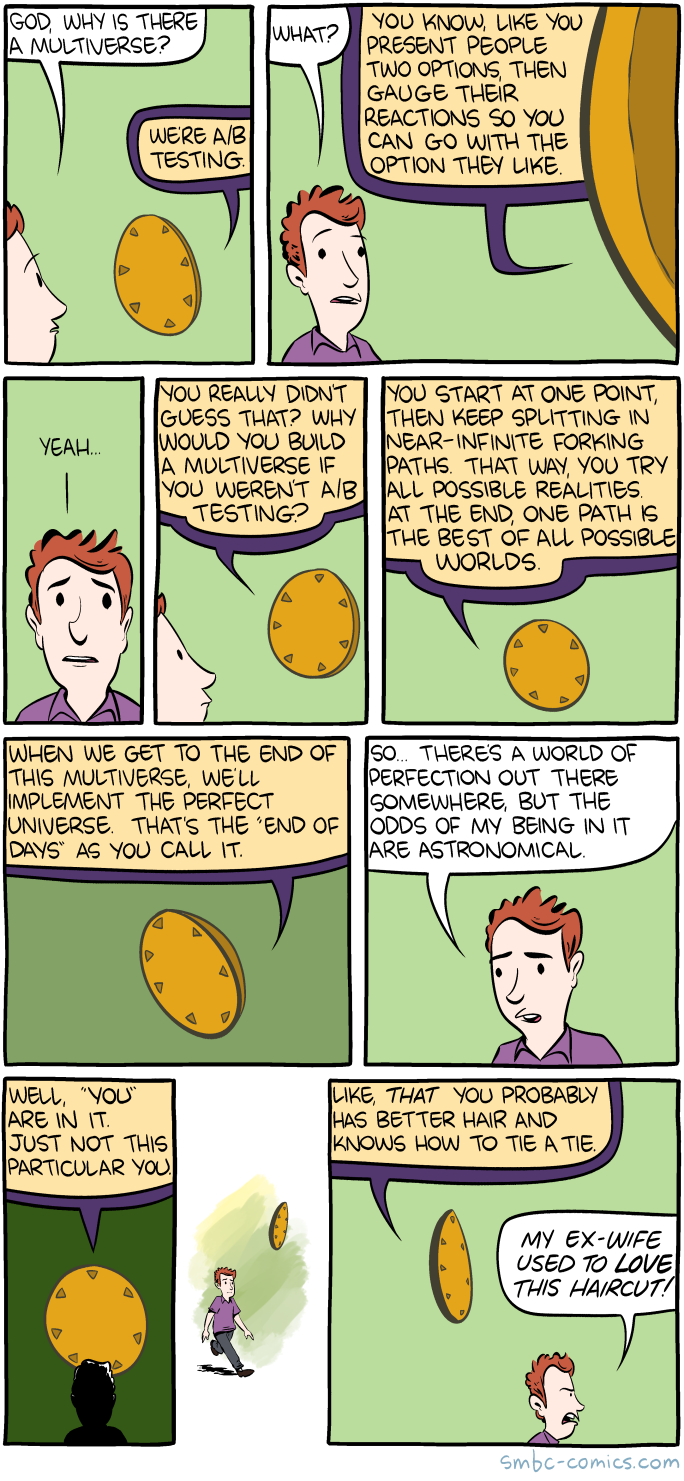
A man asks God why there are multiple universes. God explains his process: he generates options, gauges their qualities, and continues with the ones that seem fine — effectively A/B testing realities. The man recognizes this is exactly how software multivariate testing works: you start at one point, keep splitting into new variants, measure results, try all possible paths, and at the end pick the best of all possible worlds.
The man asks what happens when God reaches the end of the multivariate testing — will God implement the best version? God hesitates and says that while there is a world of perfection out there somewhere, the odds of his brain finding it are "astronomically" low. The man observes: "So you are possibly the smartest guy in the sky and you still don't know how to do a tie." God's final response is a deflecting quip about his ex-wife.
The Humor
The comic takes the philosophical concept of the multiverse and reframes it as God running a massive A/B test — the kind of optimization experiment that tech companies run on websites. This makes God sound less like an omniscient deity and more like an overwhelmed product manager who launched too many test variants and lost track of which one is the winner.
The reference to "the best of all possible worlds" is a nod to Leibniz's philosophical argument that God, being perfect, must have created the best possible world. The comic subverts this by suggesting God is using the right methodology (multivariate testing) but is too incompetent to actually find the optimal result — a very human failing projected onto the divine. The final joke about the tie and the ex-wife further deflates God's grandeur, making him seem like a regular bumbling guy.
References
The phrase "the best of all possible worlds" comes from Gottfried Wilhelm Leibniz's theodicy, articulated in his 1710 work "Essais de Theodicee." Leibniz argued that God, being omniscient and omnibenevolent, must have selected the best possible world from all conceivable alternatives. This idea was famously satirized by Voltaire in "Candide" (1759). The comic also references A/B testing and multivariate testing, standard practices in software engineering and digital marketing where multiple variants are tested simultaneously to find the optimal outcome.