the-offensive-truth
Explanation
The Joke
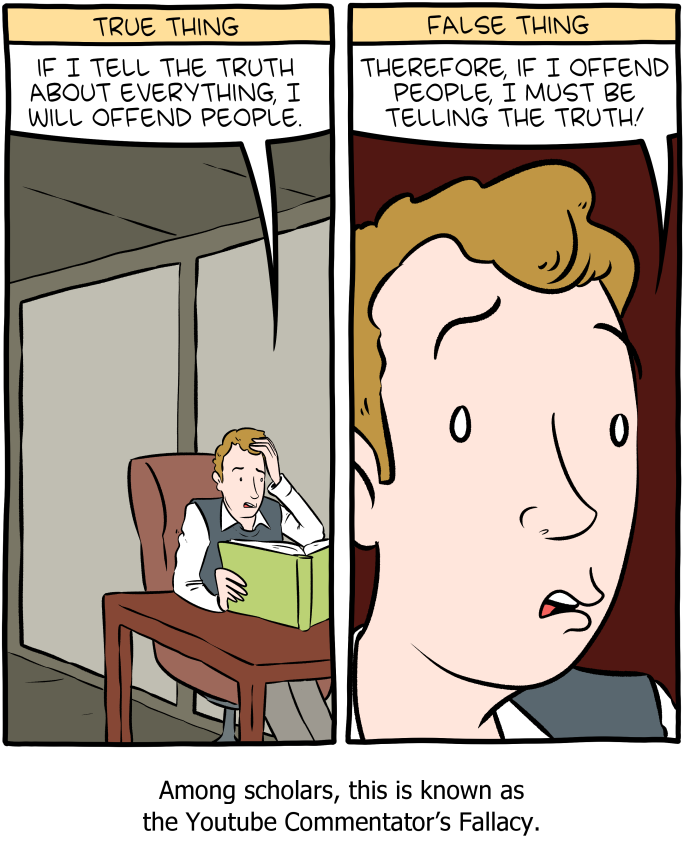
The comic presents two panels labeled "True Thing" and "False Thing." In the first panel, a man reading a book acknowledges a genuine truth: "If I tell the truth about everything, I will offend people." In the second panel, the same man makes a logical leap to a false conclusion: "Therefore, if I offend people, I must be telling the truth!" The caption below identifies this as "the Youtube Commentator's Fallacy."
The logical error on display is a textbook case of affirming the consequent. Just because truth-telling can cause offense does not mean that all offensive statements are truthful. Plenty of offensive statements are simply wrong, cruel, or both.
The Humor
The comic skewers a very common rhetorical dodge used by internet commenters (and, increasingly, public figures) who use the negative reactions they receive as evidence that they must be speaking important truths. By giving this fallacy a formal-sounding name -- "the Youtube Commentator's Fallacy" -- Weinersmith both mocks the pseudo-intellectual veneer these people adopt and highlights how transparently flawed the reasoning is. It is a compact and elegant takedown of the "I'm just saying what everyone is thinking" crowd.
References
The logical fallacy depicted is "affirming the consequent," a well-known formal fallacy in logic. The structure is: "If P, then Q; Q; therefore P" -- which is invalid. The comic applies this specifically to the culture of online discourse where being provocative is often confused with being insightful.