the-other-side-of-the-chessboard
Explanation
The Joke
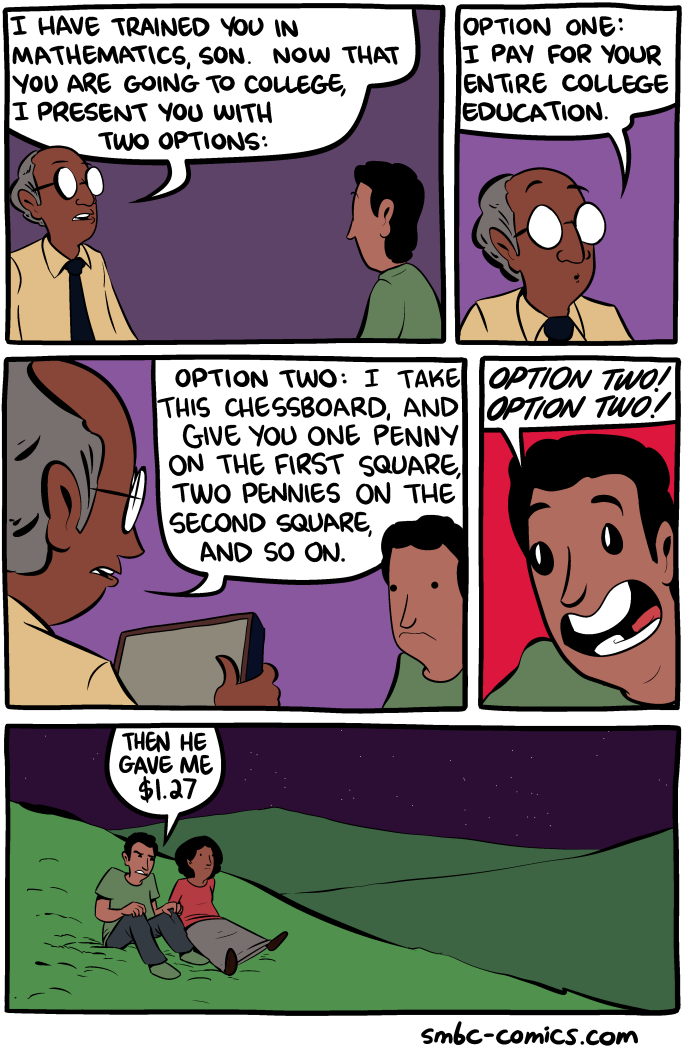
A parent tells their child, "I have trained you in mathematics. Now that you are going to college, I present you with options." Option one: "I pay for your entire college education." Option two: "I take the chessboard, and I give you one penny on the first square, two pennies on the second square, four pennies on the third square, and so on." The child eagerly shouts "Option two! Option two!"
The final panel shows the child sitting dejectedly on the ground, saying "Then he gave me $1.27."
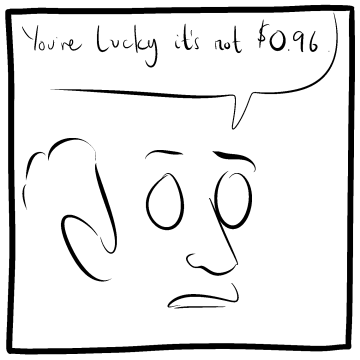
The joke is that the child recognized the classic exponential-growth chessboard problem (where doubling a penny across 64 squares yields an astronomically large sum) but failed to notice that the parent only said "and so on" without specifying they'd fill all 64 squares. The parent apparently stopped after just a few squares, giving the child a trivially small amount of money instead of a college education.
The Humor
The comedy plays on the famous wheat-and-chessboard mathematical legend, where a seemingly modest doubling scheme produces an incomprehensibly large total. The child, having been "trained in mathematics," recognizes this and smugly chooses the exponential option -- but their mathematical training failed to include the most important lesson: read the fine print. The parent never actually committed to filling all 64 squares.
There is also a layer of humor about the parent-child dynamic: the parent has essentially tricked their mathematically trained child using a deliberate rhetorical ambiguity, simultaneously saving a fortune on college tuition and teaching a harsh practical lesson that no amount of theoretical math knowledge can prevent you from being outsmarted by vague contracts. The child's training in mathematics was ironically their downfall, as they were so excited by the theoretical payout that they didn't think critically about the actual terms.
References
The comic references the wheat and chessboard problem, an ancient legend often attributed to the inventor of chess. In the classic version, the inventor asks a king for one grain of wheat on the first square, two on the second, four on the third, and so on for all 64 squares. The total comes to 2^64 - 1 grains (about 18.4 quintillion), which is more wheat than has ever been produced in human history. This problem is commonly used in mathematics education to illustrate exponential growth.