the-pleasure-button
Explanation
The Joke
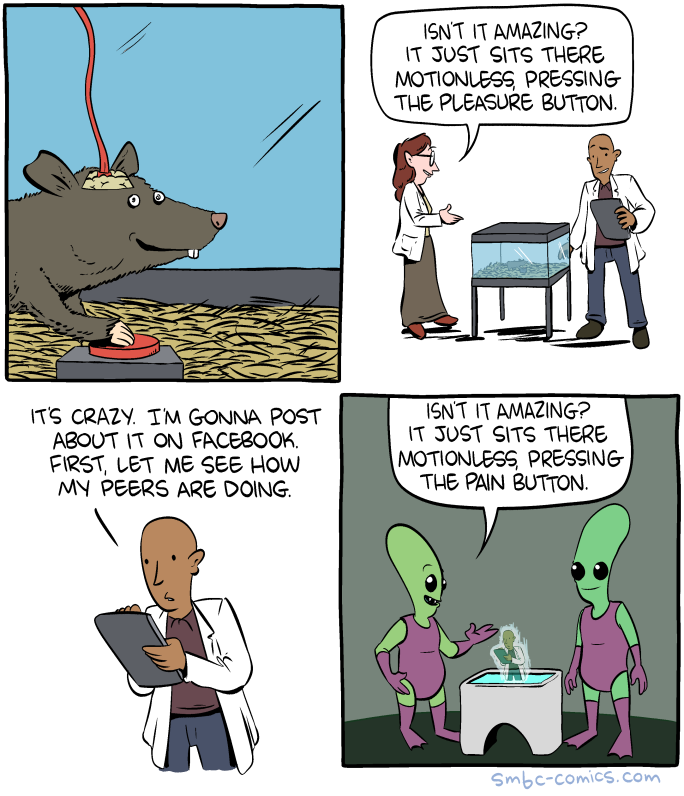
The comic is split into two parallel scenes. In the top panel, a large rat-like creature is at some kind of lever or device, and a speech bubble says something like "Isn't it amazing? It just sits there, motionlessly pressing the pleasure button." This references the classic behavioral psychology experiment where rats with electrodes implanted in their brain's reward centers will press a lever endlessly, ignoring food and water.
In the bottom panel, two aliens are sitting at a table observing humans, and one says something equivalent: "Isn't it amazing? It just sits there, motionlessly pressing the pleasure button." But in this case, the "pleasure button" is a smartphone or social media feed. One alien notes the human wants to post about it on Facebook first to check how their friends are doing. The parallel is clear: humans scrolling through social media are essentially doing the same thing as the lab rat pressing the pleasure lever.
The Humor
The joke draws a direct equivalence between lab rats mindlessly stimulating their reward centers and humans mindlessly scrolling through social media. The comic suggests that from an outside observer's perspective (the aliens), there is no meaningful difference between the two behaviors -- both creatures are locked into compulsive, repetitive stimulation of their dopamine pathways. The added detail that the human wants to check Facebook before doing anything else reinforces the addictive, compulsive nature of the behavior. The aliens serve as the detached scientific observers that humans are to the rats, completing the satirical parallel.
References
The comic references the famous experiments by James Olds and Peter Milner in the 1950s at McGill University, where rats with electrodes in their brain's septal nuclei (part of the reward system) would press a lever to receive electrical stimulation thousands of times per hour, to the exclusion of all other activities including eating. This experiment became a foundational study in understanding the brain's reward circuitry and addiction. The comic applies this finding to modern smartphone and social media addiction.