the-power-of-prayer

Explanation
The Joke
A child prays: "Dear Lord, my teacher, Ms. Stratton, is very ill. Could you cancel whatever plan you have personally selected, violate all known laws of physics, and pre-empt the fundamental mechanisms of causality itself in order to make her well?"
The child then adds: "Or if that seems improbable -- dare I say absurd -- please honor the half-hearted prayer of a young boy."
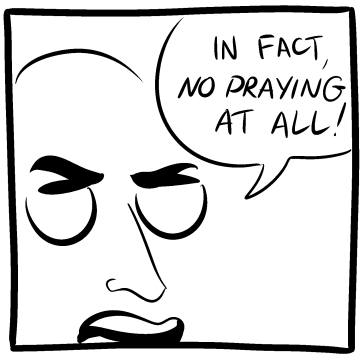
An adult (likely a parent) says: "There. Happy?" The child responds: "From now on, only silent prayers."
The Humor
The comic deconstructs the concept of prayer by having a child state explicitly what prayer implicitly asks for. When someone prays for a miracle (such as healing a sick person), they are essentially asking God to override the laws of physics, cancel his divine plan, and suspend causality -- which, when stated plainly, sounds extraordinarily presumptuous and improbable.
The child, being precociously logical, frames the prayer in these blunt terms rather than the usual vague, reverent language. The second panel drives the point home: the child acknowledges how absurd the request sounds and then notes that the alternative -- that God would change the fundamental workings of the universe because of a "half-hearted prayer of a young boy" -- is equally ridiculous.
The parent's annoyed "There. Happy?" suggests the child was forced to pray (perhaps by a religious parent), and the child's final response -- "From now on, only silent prayers" -- implies the parent does not want to hear prayers articulated this honestly. The parent prefers the comforting vagueness of traditional prayer language rather than confronting what is actually being requested. Silent prayers conveniently hide the logical absurdity.
References
- Intercessory prayer: The practice of praying to God to intervene in worldly events, such as healing illness. Scientific studies on intercessory prayer (such as the 2006 STEP study) have found no measurable effect on outcomes.
- The Problem of Evil / Divine Plan: The comic touches on a theological tension: if God has a plan, prayer asking him to change it implies either the plan is imperfect or that human requests should override divine will.