the-real-villain

Explanation
The Joke
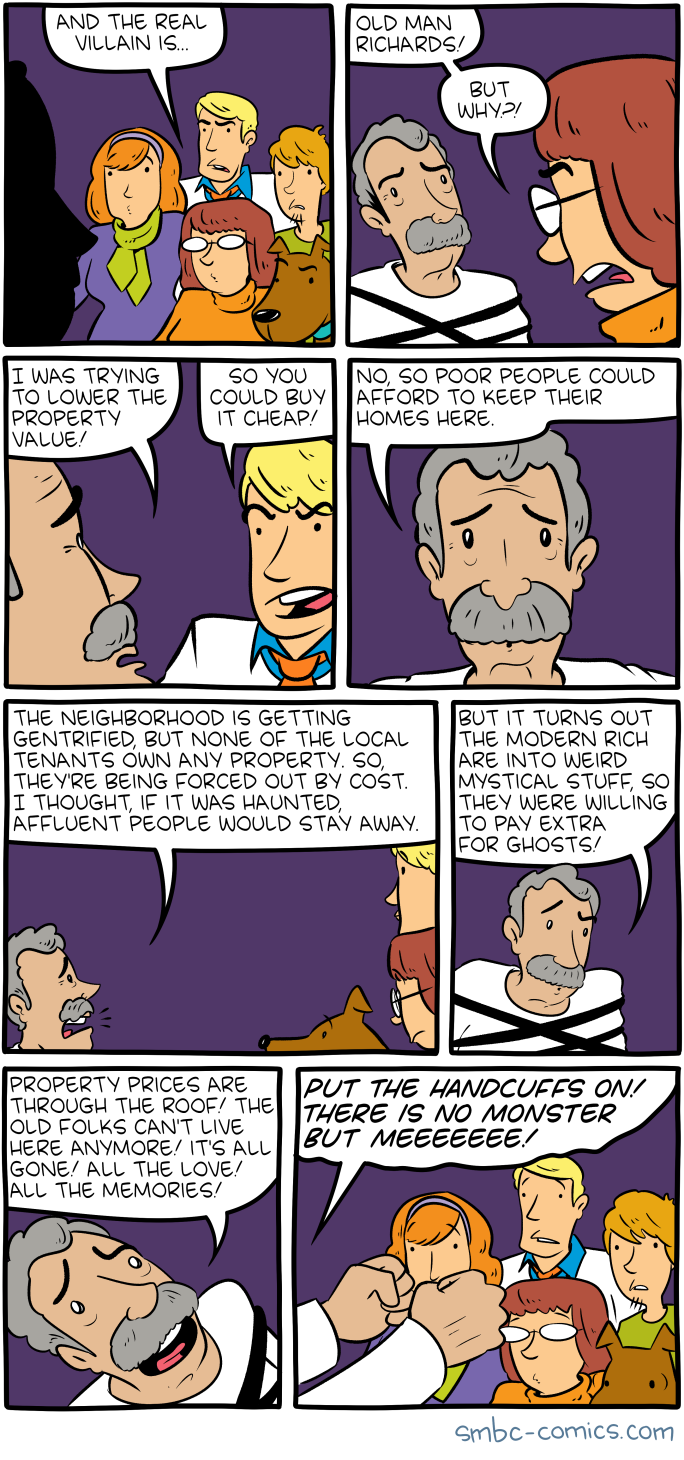
The comic reimagines the world of Scooby-Doo through the lens of gentrification. The gang unmasks the "real villain," who turns out to be an old man — but the twist is that he was trying to scare people away from the neighborhood by pretending it was haunted so that property values would stay low and long-term residents could keep their homes. The gang, by exposing him, has inadvertently enabled gentrification: now that the neighborhood is no longer "haunted," property prices will rise, wealthy newcomers will move in, and the original residents will be priced out and displaced.
The comic reframes the classic Scooby-Doo formula where the villain is always someone faking a haunting for selfish reasons. Here, the "villain" was actually performing a public service — keeping property values affordable so that ordinary people could continue living in their community. The Scooby gang, always presented as heroes, are revealed to be unwitting agents of gentrification and displacement.
The Humor
The humor works by taking the familiar, morally simple Scooby-Doo narrative and injecting real-world socioeconomic complexity. In the cartoon, unmasking the villain is always unambiguously good. But in this version, the "villain" had sympathetic motives, and the "heroes" have made things worse for the very community they were supposedly helping. The final panel, where someone pleads about the handcuffs while the gang celebrates, drives home the dark irony. It is a classic Weiner move of finding uncomfortable truths lurking inside beloved childhood entertainment.
References
The comic parodies the animated television series "Scooby-Doo, Where Are You!" (1969-present in various incarnations), in which teenage mystery-solvers and their Great Dane always discover that the seemingly supernatural villain is actually a person in a costume with a real-estate or financial motive. The concept of gentrification — where rising property values displace long-term, often lower-income residents — has been a major topic of urban policy debate.