the-satan-gene

Explanation
The Joke
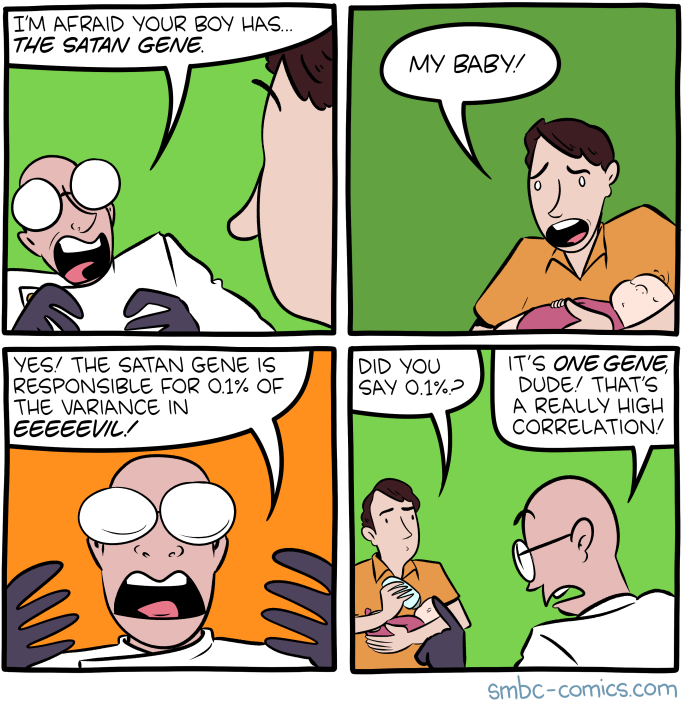
A scientist announces a disturbing discovery: "I've identified your son has the Satan Gene!" The parents react with horror: "My baby!" The scientist explains that "The Satan Gene is responsible for up to 0.03% of the variance in aggressive behavior." When asked "Do you see our concern?", the scientist cheerfully responds: "It's one gene with a really high correlation with a cool name!"
The comic satirizes the media and public tendency to sensationalize genetic research findings. The "Satan Gene" sounds terrifying -- it evokes images of innate evil -- but the actual statistical impact is absurdly tiny: 0.03% of variance in aggression. The scientist is not concerned at all; he is excited because the gene has a dramatic name, not because it has meaningful predictive power.
The Humor
The joke targets the gap between how genetic findings are named and marketed versus what they actually mean statistically. In real behavioral genetics, individual genes typically account for minuscule fractions of variance in complex traits like aggression. But a gene called "the Satan Gene" sounds like it should predict whether your child will become a supervillain. The scientist's enthusiasm for the "cool name" rather than the negligible effect size perfectly captures how science communication often prioritizes sensational framing over statistical literacy. The parents' panic over a 0.03% variance contribution is the comic's way of showing how easily people can be frightened by genetics when the findings are dressed up in alarming language.
References
The comic parodies the "warrior gene" (MAOA), which received widespread media attention for its association with aggression, despite accounting for only a small portion of behavioral variance. More broadly, it satirizes the trend of naming genes with dramatic labels (like "the God gene" or "the psychopath gene") that vastly overstate their individual predictive power.