the-silent-majority
Explanation
The Joke
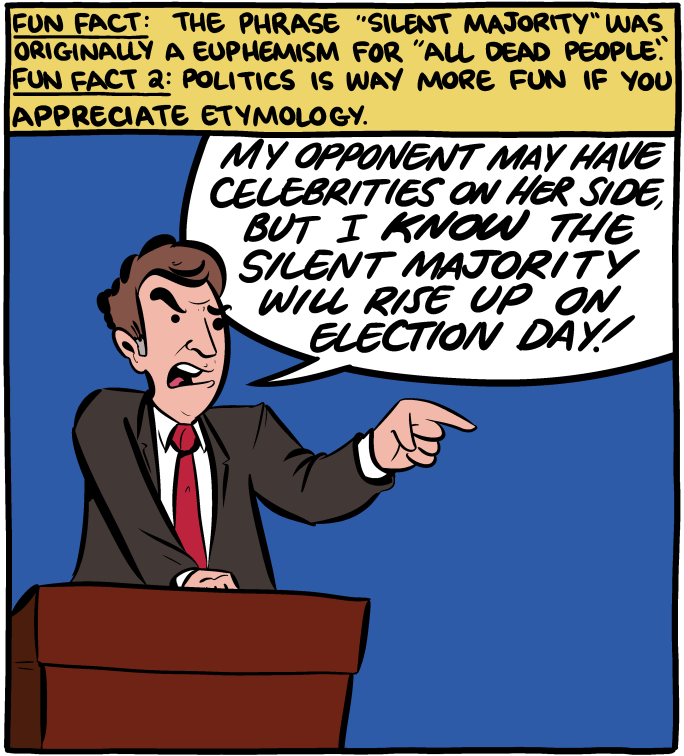
The comic opens with a "fun fact" header: "The phrase 'silent majority' was originally a euphemism for 'all dead people.' Fun Fact 2: Politics is way more fun if you appreciate etymology."
Below, a politician at a podium declares: "My opponent may have celebrities on her side, but I know the silent majority will rise up on election day!"
The joke is that if you take "silent majority" in its original meaning (dead people), the politician is essentially promising that the dead will rise from their graves on election day -- turning a standard political rallying cry into an apocalyptic zombie scenario.
The Humor
The humor relies on the double meaning of "silent majority." In modern political usage, popularized by Richard Nixon in 1969, the term refers to a large group of people who do not express their opinions publicly but whose views are assumed to align with the speaker's position. However, the original and older usage of "silent majority" referred to the dead -- those who have been permanently silenced. By pointing out this etymology, the comic transforms a cliched political promise into an unintentionally hilarious image of the dead rising up to vote. The phrase "rise up" makes the zombie interpretation even more vivid. The meta-joke in "Fun Fact 2" -- that politics is more fun if you appreciate etymology -- is Weinersmith's way of saying that knowing word origins can turn mundane political rhetoric into comedy.
References
- "Silent majority" was a phrase famously used by U.S. President Richard Nixon in a 1969 speech to refer to Americans who did not participate in anti-Vietnam War protests. The phrase predates Nixon, however, and was historically used as a euphemism for the dead.
- The older euphemistic meaning traces back to at least the 19th century and has roots in classical references to the dead as the majority of all humans who have ever lived.