the-strong
Explanation
The Joke
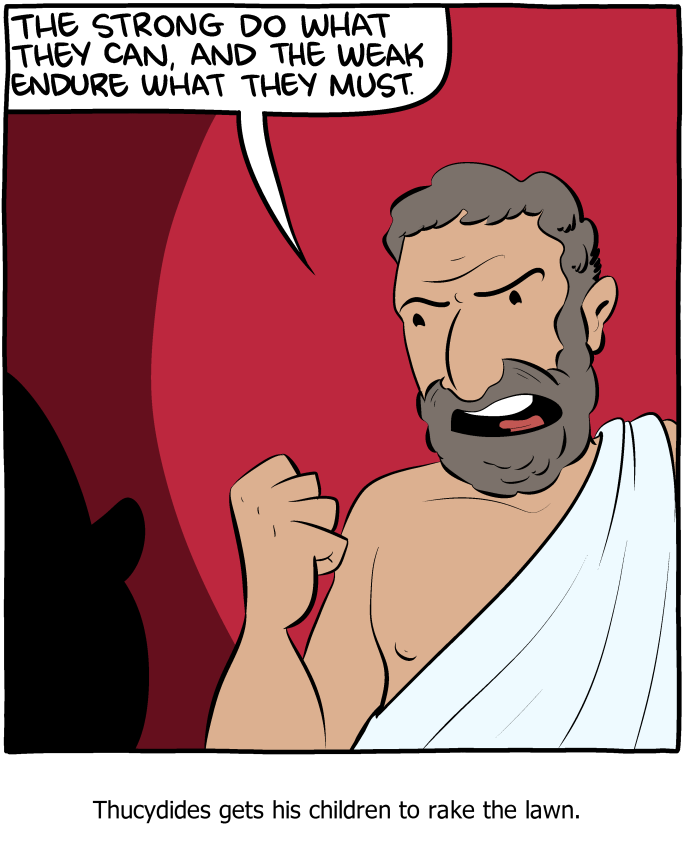
The comic shows a figure in ancient Greek attire, depicted with dramatic intensity, declaring: "The strong do what they can, and the weak endure what they must." This is one of the most famous and chilling lines from ancient political philosophy, originally from Thucydides' account of the Melian Dialogue. The caption beneath the panel reads: "Thucydides gets his children to rake the lawn."
The joke recontextualizes this grand, dark statement about geopolitical power -- originally spoken by Athenian envoys threatening the people of Melos with annihilation -- as a parent bullying his kids into doing yard work. The father is using this sweeping philosophical declaration about the nature of power to justify making his children do chores.
The Humor
The humor lies in the absurd mismatch of scale. Thucydides recorded this line in the context of Athens threatening to destroy an entire island nation if it did not submit. Here, that same iron logic of domination is being applied to lawn maintenance. The comic suggests that the underlying dynamic is actually the same: a more powerful party (the parent) forcing a weaker party (the children) to comply, just at a dramatically smaller and more mundane scale.
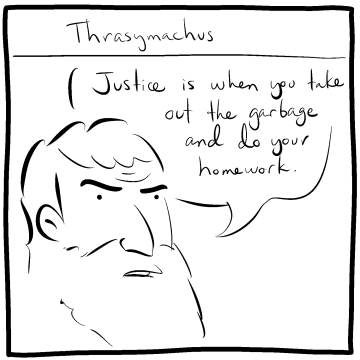
The votey panel extends the joke by showing another Greek figure, labeled Thrasymachus, declaring "Justice is when you take out the garbage and do your homework." This references Thrasymachus' famous argument in Plato's Republic that "justice is the advantage of the stronger" -- again repurposed as a parent using philosophy to make kids do chores.
References
The main quote is from Thucydides' History of the Peloponnesian War (5.89), specifically the Melian Dialogue (416 BCE), in which Athenian ambassadors tell the neutral island of Melos that might makes right and that they must submit or be destroyed. Thrasymachus appears in Book I of Plato's Republic, where he argues that justice is merely whatever serves the interests of the powerful. Both are foundational texts in political realism and philosophy of justice.