The Village and the Tower

Explanation
The Joke
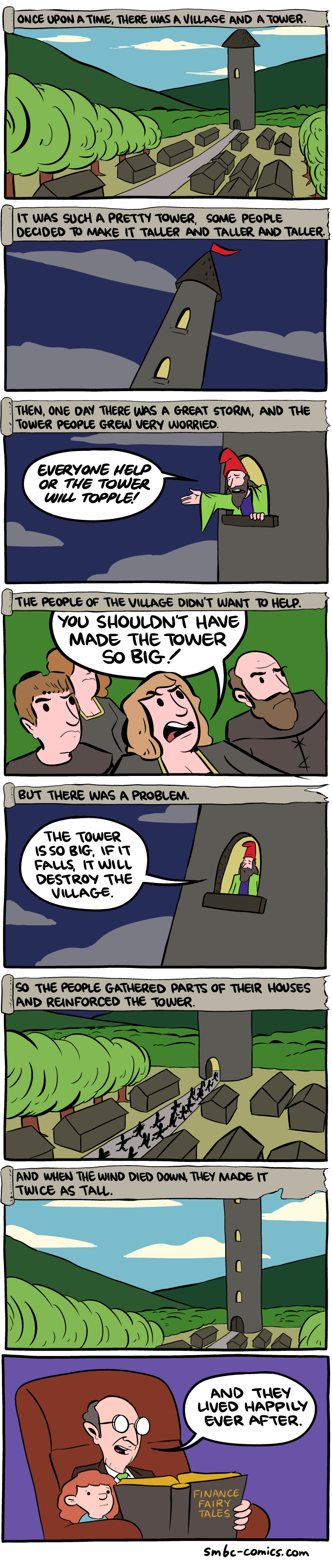
The comic tells a fairy-tale-style story about a village with a tower. The villagers loved the tower and kept building it taller and taller. One day a great storm came, and the tower people grew very worried. The villagers below called up to them: "You shouldn't have made the tower so big!" But the tower was so big it still stood through the storm. The people then gathered at its base, reinforced it, and made it twice as tall. When it eventually did come down, they simply rebuilt it. The final panel shows a woman reading this story to a child, concluding: "And they lived happily ever after."
The story is an allegory for human progress and resilience. Unlike typical cautionary tales (like the Tower of Babel) where hubris leads to destruction, this story subverts expectations: the tower survives the storm, the naysayers are wrong, and when it does eventually fall, the people just rebuild it bigger. The moral is pro-ambition and pro-progress.
The Humor
The comic subverts the expected structure of cautionary fables. The reader anticipates a "pride goeth before a fall" narrative where the tower collapses and the villagers learn a lesson about overreaching. Instead, the tower survives, the critics are proven wrong, and even when the tower does fall later, it is treated as a non-event -- they just rebuild. The humor is in how cheerfully it rejects the typical pessimistic moral of such stories. The framing as a bedtime story adds another layer, as it implies this optimistic, pro-engineering worldview is being taught to children instead of the usual cautionary tales. This is very much in line with Zach Weinersmith's generally pro-science, pro-progress worldview.
References
The comic is a clear inversion of the Tower of Babel story from Genesis 11:1-9, in which humanity builds a tower to reach heaven and God scatters them and confuses their languages as punishment for their hubris. It may also reference the broader literary tradition of cautionary tales about human overreach, such as the myth of Icarus or Mary Shelley's Frankenstein.