theodicy

Explanation
The Joke
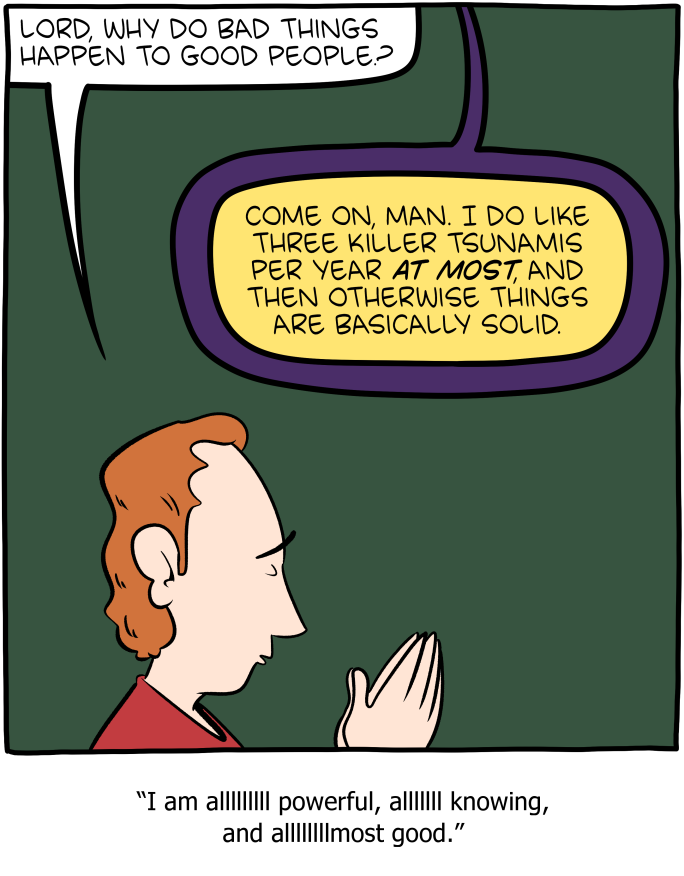
A man prays to God, asking the classic theological question: "Lord, why do bad things happen to good people?" God responds in an exasperated, defensive tone: "Come on, man. I do like three killer tsunamis per year AT MOST, and then otherwise things are basically solid." The caption below reads: "I am allllllll powerful, alllllll knowing, and alllllllllmost good."
The joke takes the philosophical problem of theodicy — why an omnipotent, omniscient, and omnibenevolent God would allow suffering — and has God essentially concede the point while minimizing it. God doesn't deny causing suffering; He just argues that He keeps it to a reasonable minimum, as if a handful of devastating natural disasters per year is an acceptable track record. The caption modifies the traditional theological attributes: God is all-powerful and all-knowing, but only "almost" good — a small but devastating qualifier.
The Humor
The comedy lies in God treating the problem of evil like a performance review. His defense — "only three killer tsunamis a year, tops" — mirrors the way someone might downplay poor job performance by arguing it's not that bad relative to how much worse it could be. The elongated "allllllll" in the caption builds the expectation that all three divine attributes will be affirmed, only to deliver the deflating "alllllllllmost good" at the end. The joke suggests that the simplest resolution to the problem of theodicy is the one theologians least want to consider: God is simply not perfectly benevolent, just pretty good — like a mostly competent employee who occasionally lets a catastrophe slip through.
References
- Theodicy: The branch of theology and philosophy concerned with reconciling the existence of evil and suffering with an omnipotent, omniscient, and omnibenevolent God. The term was coined by Gottfried Leibniz in 1710.
- The Problem of Evil: One of the oldest philosophical challenges to theism, formulated in various ways from Epicurus to contemporary philosophers like J.L. Mackie and Alvin Plantinga.
- Omni-attributes of God: The traditional theological claim that God is omnipotent (all-powerful), omniscient (all-knowing), and omnibenevolent (all-good).