theorem
Explanation
The Joke
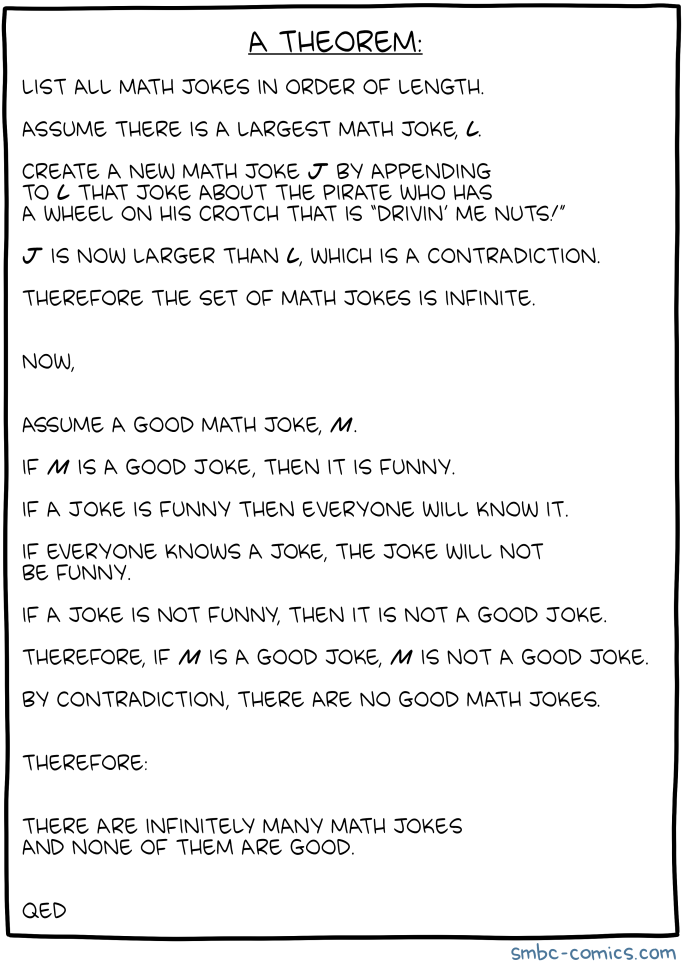
The comic presents "A Theorem" written in the style of a formal mathematical proof, but applied to math jokes. The proof proceeds in two parts. First, it proves that the set of math jokes is finite by assuming there is a largest math joke and showing a contradiction (you could always make a joke about the person who made the largest math joke). Wait -- actually, it proves the set is infinite via that reasoning, then pivots.
The second part assumes "a math joke, M." It argues: if M is a good joke, then it is funny; if it is funny, then everyone will already know it (because good jokes spread); if everyone knows it, then it is not funny (because familiarity kills humor); therefore, if M is a good joke, then M is not a good joke -- a contradiction. By contradiction, there are no good math jokes. The theorem concludes: "There are infinitely many math jokes and none of them are good. QED."
The Humor
The comic is itself a math joke that proves math jokes are all bad -- making it a self-referential paradox. The proof structure is a loving parody of real mathematical proof techniques (proof by contradiction, reductio ad absurdum), applied to a decidedly non-mathematical subject. The conclusion -- that there are infinitely many math jokes but none of them are good -- is funny precisely because anyone who has sat through a math lecture knows it to be empirically true. The fact that this is delivered as a formally structured theorem makes it simultaneously a math joke and a critique of math jokes, which is the kind of recursive humor that mathematicians particularly enjoy.
References
- The proof style parodies standard techniques in mathematical logic, particularly proof by contradiction (assuming the opposite of what you want to prove and deriving a contradiction) and the structure of classic proofs like Euclid's proof that there are infinitely many primes.
- "QED" (quod erat demonstrandum, Latin for "which was to be demonstrated") is the traditional sign-off for a completed mathematical proof.