things-have-changed

Explanation
The Joke
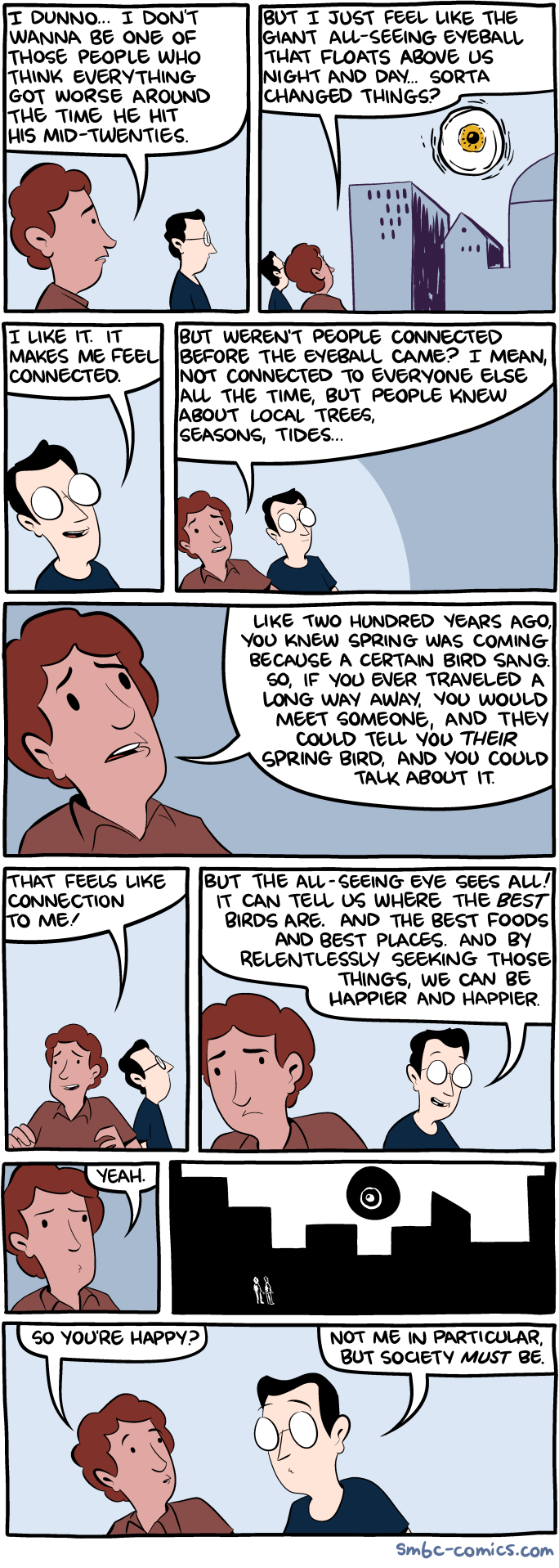
The comic is a philosophical conversation between two people about the internet and modern connectivity. One person says he doesn't want to be one of those people who think everything got worse around the time the internet arrived, calling it "his mid-Luddite phase." But he also feels that the "giant eyeball" (representing the internet or social media) that floats above them, tracking everything day and night, has "sorta changed things."
The other person pushes back: weren't people connected before the internet? They knew about local trees, seasons, and tides. And two hundred years ago, if you knew spring was coming because a certain bird sang, and you traveled far away, you could meet someone who could tell you about their spring bird and you could bond over that. "That feels like connection to me," says the first person. But the second responds that the all-seeing eye can show us the best birds, the best foods, and the best places, and "by relentlessly seeking those things, we can be happier and happier."
The first person asks "So you're happy?" The devastating reply: "Not me in particular, but society must be."
The Humor
The punchline perfectly captures the paradox of modern technology optimism. The character has argued eloquently that the internet and its all-seeing algorithms should make us happier by optimizing everything -- but when confronted with the simple personal question of whether this has actually worked for them individually, they admit it hasn't. The disconnect between "society must be happier" (based on theory) and "not me in particular" (based on lived experience) is both funny and deeply melancholy. It satirizes the tendency to defend technology with abstract utilitarian arguments while personally experiencing its downsides.
The votey panel shows a giant eyeball -- the same all-seeing eye of the internet from the comic -- reinforcing the surveillance theme and the idea that we are all being watched by the digital panopticon we have willingly created.
References
The comic references Luddism, the early 19th-century movement of English textile workers who opposed new labor-saving machinery. In modern usage, "Luddite" refers to anyone skeptical of or opposed to new technology. The "giant eyeball" metaphor evokes the concept of the Panopticon, a type of prison designed by philosopher Jeremy Bentham in which inmates could be observed at all times, later used by Michel Foucault as a metaphor for modern surveillance society. The discussion also touches on themes from sociological research about whether social media and internet connectivity actually increase happiness and social connection, a topic studied extensively by researchers like Sherry Turkle ("Alone Together") and Jean Twenge ("iGen").