Thinning the Herd
Explanation
The Joke
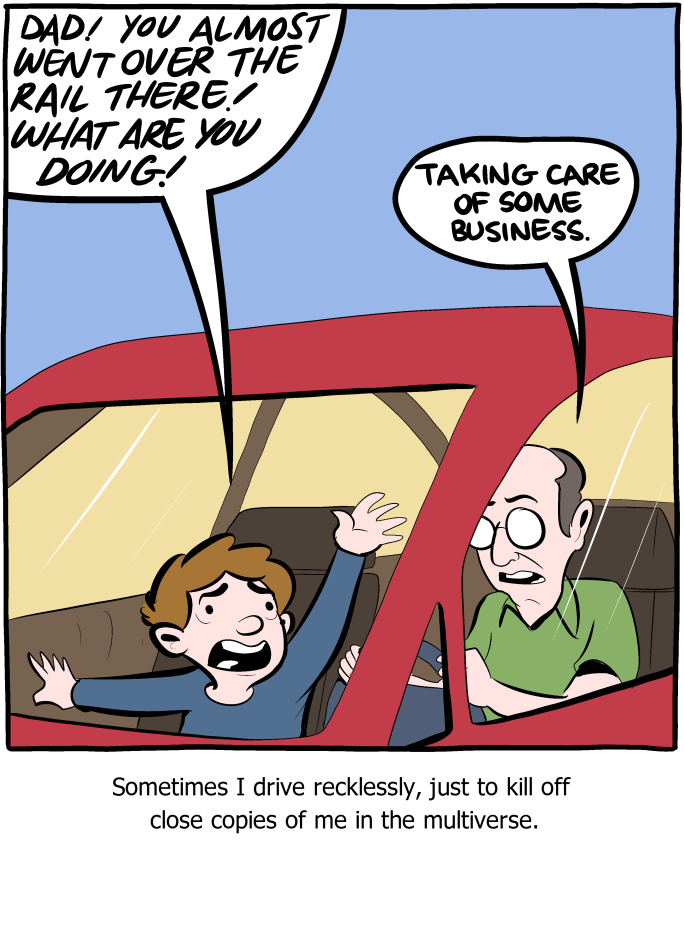
A child is panicking in the passenger seat as his father nearly drives the car over a railing. When the child asks what he's doing, the father calmly replies he's "taking care of some business." The caption below reads: "Sometimes I drive recklessly, just to kill off close copies of me in the multiverse."
The joke is based on the many-worlds interpretation of quantum mechanics, which posits that every possible outcome of every event exists in a parallel universe. The father has taken this to a darkly absurd extreme: he reasons that by driving recklessly, he can "thin the herd" of his alternate-universe copies. In the universes where the reckless driving results in a fatal crash, those versions of him die, while he survives in this universe. He's essentially trying to reduce the number of parallel versions of himself that exist.
The Humor
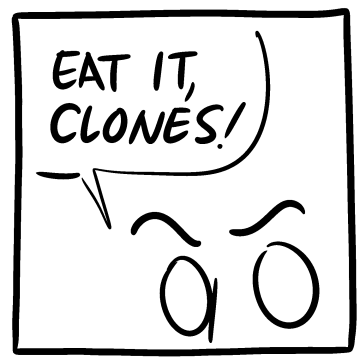
The comedy comes from the collision between a high-concept physics idea and the mundane horror of reckless driving. The father treats the many-worlds interpretation not as an abstract philosophical framework but as a practical problem requiring action — there are too many copies of him, and he needs to eliminate some. His calm demeanor while nearly killing himself and his son adds to the dark absurdity. The title "Thinning the Herd" reframes what is essentially a suicide attempt as sensible population management, but for one's own multiversal selves.
References
- Many-worlds interpretation: A theory in quantum mechanics proposed by Hugh Everett III in 1957, suggesting that all possible outcomes of quantum measurements are physically realized in separate, branching universes. It is sometimes called the "multiverse" interpretation in popular culture.