thought

Explanation
The Joke
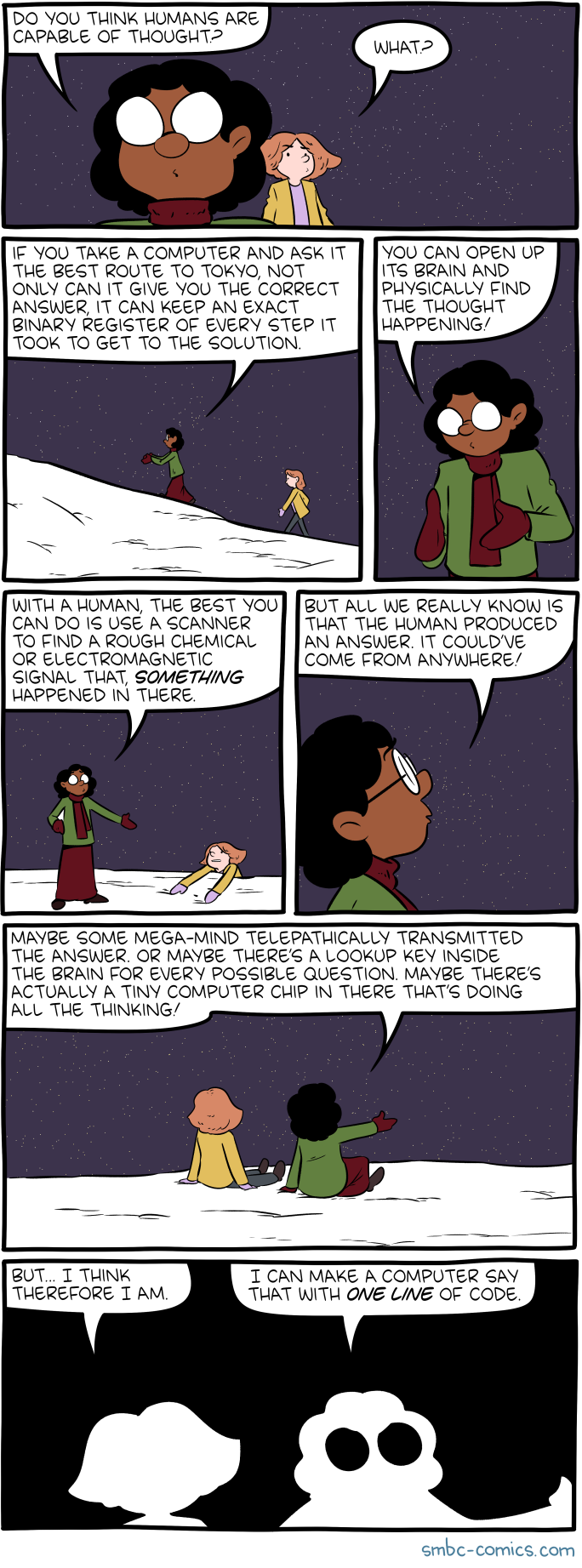
Two characters discuss whether humans are capable of thought. One explains the computational analogy: if you ask a computer for the best route between two points, it gives a precise answer and can report exactly how many steps it took to reach the solution. With a human, if you ask the best route, they might give a rough, vaguely correct answer like "something northish in that direction."
The comic then explores what might be happening inside the human brain -- maybe it uses some electrochemically transmitted signal, or maybe there is literally a tiny computer chip inside doing all the real thinking. The final punchline comes when one character confidently declares "I can make a computer say that with one line of code," implying that the human's vague, hand-wavy responses are so simple and imprecise that they could be replicated by the most trivial of programs.
The Humor
The joke inverts the typical framing of artificial intelligence debates. Instead of asking "Can computers think like humans?", it asks the reverse: "Can humans think at all?" The humor lies in the unflattering comparison -- when you actually examine how imprecise, vague, and unreliable human reasoning is compared to computational processes, it starts to look less like genuine thought and more like a crude approximation. The final line about replicating human output with "one line of code" is the comedic dagger, suggesting that human cognition is not impressively complex but embarrassingly simple.
References
The comic touches on themes from philosophy of mind and artificial intelligence, particularly the Chinese Room argument and debates about what constitutes genuine "thought" versus mere information processing. It also plays on the Dunning-Kruger effect in reverse -- humans assume they are thinking deeply when they may just be producing rough heuristic guesses.