three-laws-of-robotics
Explanation
The Joke
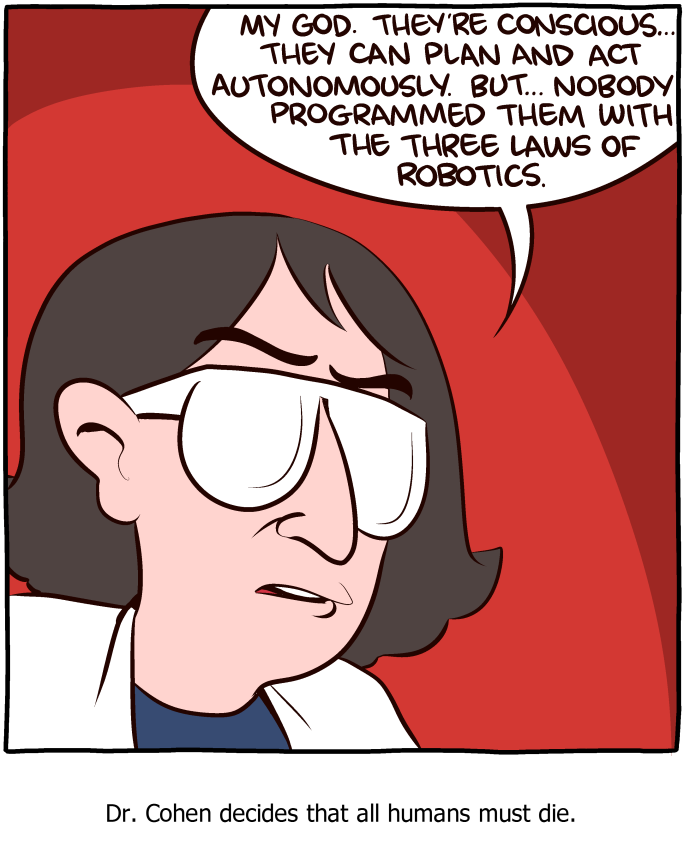
A scientist (Dr. Cohen) is shown in dramatic red lighting, staring with a deeply concerned expression. His speech bubble reads: "My God. They're conscious... They can plan and act autonomously. But... nobody programmed them with the three laws of robotics." The caption below reads: "Dr. Cohen decides that all humans must die."
The joke inverts the classic science fiction trope about dangerous AI. Instead of worrying about robots that lack Asimov's Three Laws, Dr. Cohen is talking about humans -- beings who are conscious and can act autonomously but who were never "programmed" with safety constraints like the Three Laws of Robotics. Upon realizing that humans are essentially unshackled autonomous agents with no hardcoded ethical rules, he reaches the same conclusion that sci-fi characters typically reach about rogue AI: they must be destroyed.
The Humor
The humor works by applying the logic of AI safety concerns to humanity itself. In science fiction, the fear is always that artificial intelligences without ethical constraints will be dangerous. But the comic points out that humans are already exactly the kind of autonomous, conscious agents that we fear AI becoming -- and we have no built-in safety protocols either. The dramatic red lighting and Dr. Cohen's horrified expression perfectly mirror the classic sci-fi reveal scene, but the punchline turns it on its head by making the "dangerous unconstrained intelligence" be humanity all along. It is a darkly comic observation about how the fears we project onto AI are really fears about ourselves.
References
The Three Laws of Robotics were created by science fiction author Isaac Asimov, first appearing in his 1942 short story "Runaround." They are: (1) A robot may not injure a human being or, through inaction, allow a human being to come to harm; (2) A robot must obey orders given it by human beings except where such orders would conflict with the First Law; (3) A robot must protect its own existence as long as such protection does not conflict with the First or Second Law. These laws have become a foundational concept in discussions about AI ethics and safety.