time-machine
.png)
Explanation
The Joke
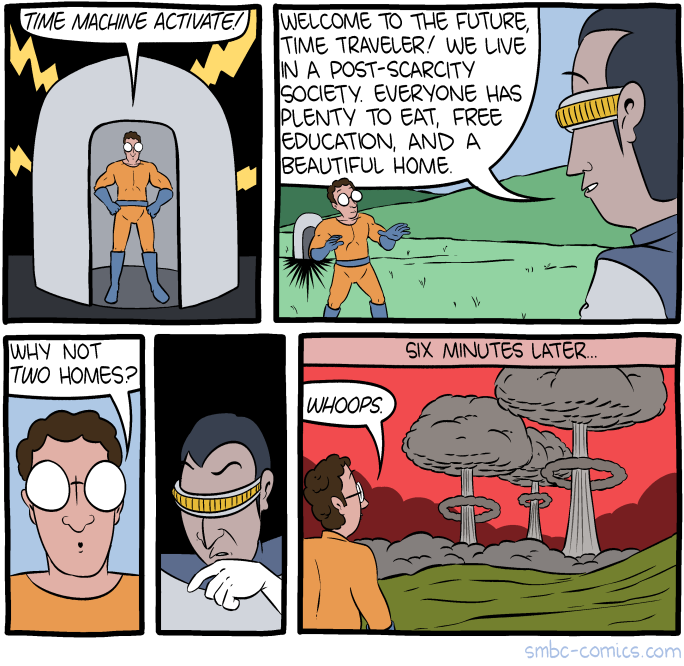
The comic opens with a "time machine activated" panel showing someone stepping into a time machine. They announce: "Welcome to the future, time traveler! We live in a post-scarcity society. Everyone has plenty to eat, free education, and a beautiful home." The next panel shows the time traveler being given "only two homes" -- and the traveler is disappointed or shocked.
Six months later, a mushroom cloud rises in the background, implying nuclear war or total civilizational collapse. The joke is that even in a utopian post-scarcity future where everyone's needs are met, humans managed to destroy everything -- presumably because "only two homes" was perceived as insufficient, or because human nature's tendency toward conflict, jealousy, and dissatisfaction persists regardless of material abundance.
The Humor
The comic satirizes the idea that material abundance would solve human conflict. Post-scarcity is a common utopian concept in science fiction -- the idea that if technology could provide unlimited resources, war and suffering would end. The comic punctures this optimism by showing that even when everyone has food, education, and housing, the civilization still self-destructs within six months. The implication is that human dissatisfaction and conflict are not driven by scarcity but by something more fundamental in human psychology -- perhaps status competition, relative comparison, or simply boredom. The mushroom cloud is the ultimate punchline: we solved every material problem and still found a reason to blow ourselves up.
References
Post-scarcity economics is a theoretical concept explored in science fiction works like Iain M. Banks' Culture series and in Star Trek's Federation. The comic engages with the philosophical question of whether eliminating material want would actually produce peace, a debate with roots in Thomas Hobbes, Jean-Jacques Rousseau, and modern behavioral economics.