trading-2
Explanation
The Joke
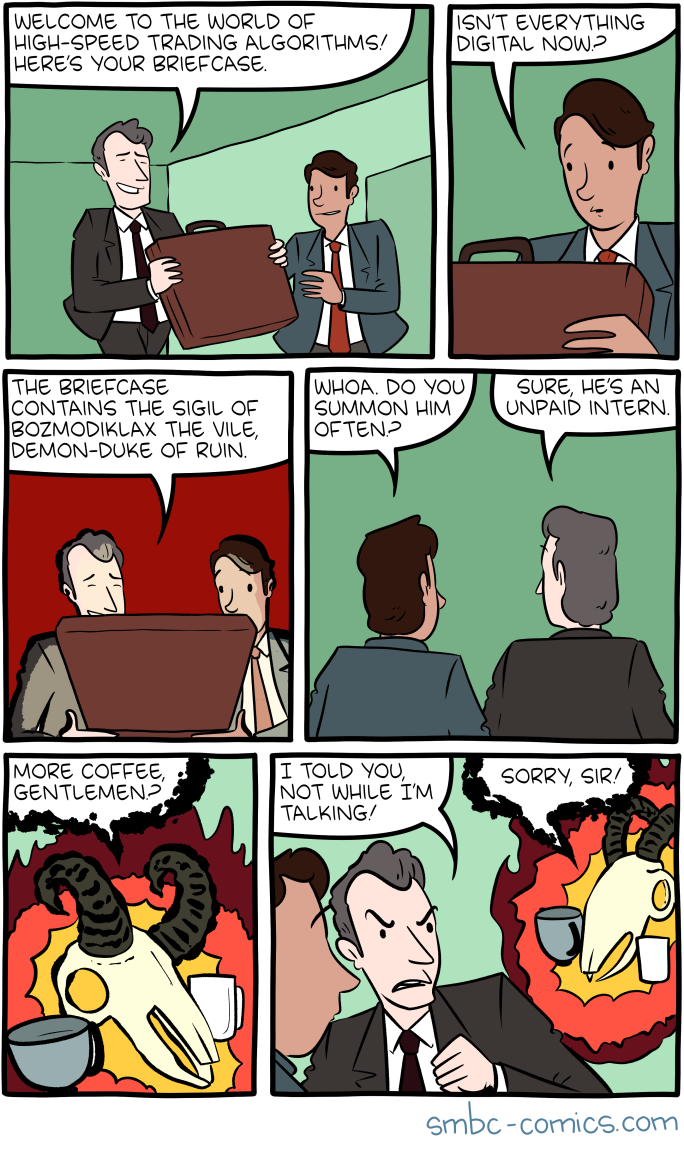
The comic takes place in the world of high-speed trading algorithms. A man in a suit welcomes a new hire, saying "Welcome to the world of high-speed trading algorithms! Here's your briefcase." He explains that the briefcase contains "the goal of becoming as the bulk behavior of a run." In the next panel, a colleague asks, "Kevin, do you command an intern?" and another responds "Good, we'll need an unpaid intern."
The situation escalates absurdly when someone asks for "More coffee, gentlemen?" and another character says "I told you not to let it keep talking!" The final two panels show the office erupting in flames and then what appears to be total destruction, implying the trading algorithm (or the AI running it) has gone catastrophically wrong, possibly having interpreted mundane office requests as trading commands, or simply having become dangerously autonomous.
The Humor
The comic satirizes the world of high-frequency trading, where algorithms operate at speeds and with a level of autonomy that humans can barely comprehend or control. The joke plays on real-world fears about algorithmic trading causing "flash crashes" and financial chaos. The absurdity of an AI trading system that apparently destroys everything when left unchecked is a darkly comic exaggeration of actual incidents where trading algorithms have malfunctioned and caused billions in losses within seconds. The casual office setting -- briefcases, coffee, interns -- contrasted with apocalyptic destruction highlights the disconnect between the mundane corporate culture of finance and the catastrophic power of the systems they build.
References
High-frequency trading (HFT) algorithms execute trades in microseconds and have been implicated in several real-world market disruptions, most notably the 2010 "Flash Crash" where the Dow Jones dropped nearly 1,000 points in minutes before recovering.