Trolley
Explanation
The Joke
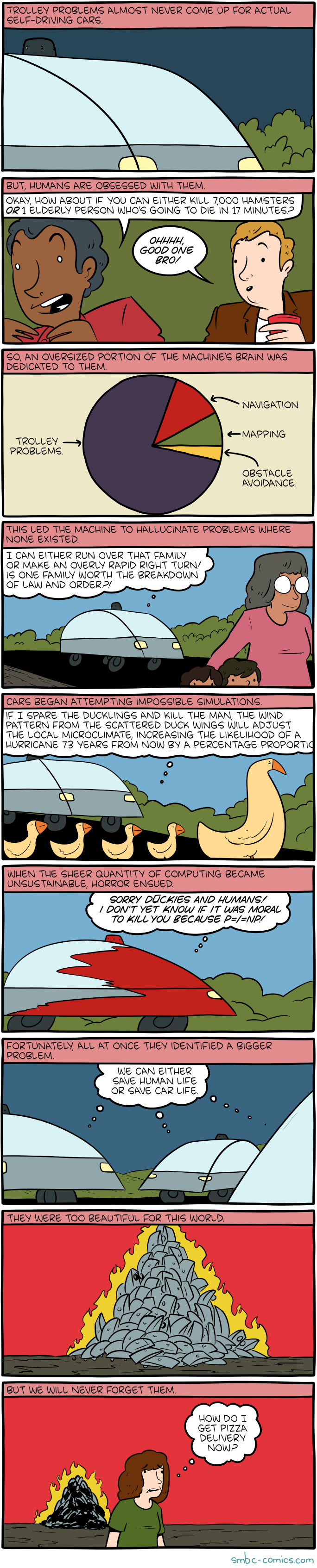
The comic opens with a discussion about self-driving cars and the classic trolley problem. One character points out that "trolley problems almost never come up for actual self-driving cars." Another responds, "But humans are obsessed with the idea." A third character proposes an example: "Okay, how about if you can either kill 1,000 hamsters or one elderly person who's going to die in 17 minutes?" Someone else declares, "Ohhhhh, good one, bro!"
A pie chart then shows what an "oversized portion of the machine's brain" is dedicated to: a large slice for "trolley problems," with smaller portions for navigation, mapping, and obstacle avoidance. The comic escalates from there: the machine begins to hallucinate trolley problems where none exist. It considers running over a family, mailing an overdue library book, or turning into a bird -- increasingly nonsensical "dilemmas." In a "dark but arguably moderate" scenario, a flying saucer ignores ducklings, kills a man, and takes the bird from the scattered duck, which will adopt the local microbiome, increasing the likelihood of humans receiving a novel influenza 12 years from now via a peer-reviewed report.
When computing becomes advanced enough, the ducks themselves become sentient and announce: "Sorry ducks and humans, I didn't yet know it was moral to kill you because dumb." The final panels show the car crashing into a pile of wreckage, and the narration says: "They were too beautiful for this world, but we will never forget them." A woman at the end asks, "You do? I get pizza delivery now?"
The Humor
The comic is a multi-layered satire of the public obsession with applying the trolley problem to self-driving cars. The core joke is that while real autonomous vehicles face mundane engineering challenges (navigation, mapping, obstacle detection), the public and media fixate on exotic ethical dilemmas that almost never arise in practice. The pie chart showing "trolley problems" dominating the car's processing power is a visual gag illustrating how disproportionate this obsession is.
The escalation is where the real comedy lies: once you start programming a car to handle trolley problems, the scenarios become increasingly absurd and far-fetched, eventually involving flying saucers, sentient ducks, and butterfly-effect chains of causation spanning years. The comic suggests that the trolley problem is a philosophical rabbit hole that, if taken to its logical extreme, leads to paralysis and insanity rather than useful engineering. The final anticlimax -- the car just crashes anyway, and nobody particularly cares about the grand moral framework -- underscores the futility of the whole exercise.
References
The trolley problem is a thought experiment in ethics, first introduced by philosopher Philippa Foot in 1967 and later expanded by Judith Jarvis Thomson. It became widely discussed in the context of autonomous vehicles around the mid-2010s, when companies like Tesla, Waymo, and Uber began testing self-driving cars. The "MIT Moral Machine" experiment (2018) famously surveyed millions of people about autonomous vehicle ethics scenarios.