trust-3

Explanation
The Joke
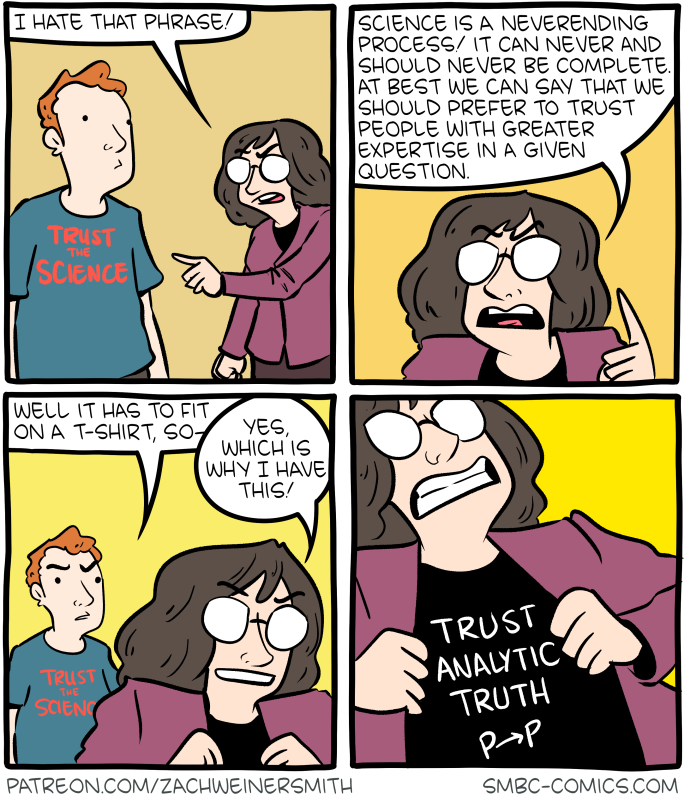
A character declares "I hate that phrase" (presumably some commonly used expression). Another character launches into a defense of science as a "neverending process" — explaining that science can never be complete, and that its real value is that it gives people with greater purpose the tools to achieve their goals.
The first character responds with something like "Well it has kind of a cult-y vibe..." and asks "Have I gone too far?" The final panel reveals a character wearing a T-shirt that reads "TRUST ANALYTIC TRUTH" — a hilariously niche philosophical rallying cry that looks like a slogan T-shirt but is about formal logic rather than anything inspiring or rebellious.
The Humor
The comedy works on multiple levels. First, there is the mismatch between the passionate defense of science as a noble, never-ending pursuit and the deflating observation that the way it is being expressed sounds "cult-y." This satirizes the tendency of science enthusiasts to adopt the rhetorical patterns of religious evangelism — fervent declarations, appeals to higher purpose, and absolute certainty — while ostensibly championing doubt and inquiry.
The punchline is the T-shirt reading "TRUST ANALYTIC TRUTH." Analytic truths are statements that are true by definition or by virtue of the meanings of their words (e.g., "all bachelors are unmarried"). They are the least controversial, most tautological category of truth in philosophy. Putting this on a T-shirt as though it were a bold, rebellious stance is inherently absurd — it is like wearing a shirt that says "BELIEVE IN DEFINITIONS." The humor comes from the gap between the combative, slogan-style presentation and the utterly uncontroversial content.
The comic also pokes fun at the "Trust Science" slogan culture, where complex epistemological positions get reduced to bumper stickers and T-shirts. By substituting "analytic truth" for "science," the comic highlights how meaningless these slogans become when you actually drill down into what kind of truth you are asking people to trust.
Context
"Analytic truth" is a concept from philosophy, most associated with Immanuel Kant and later the logical positivists. An analytic statement is one whose truth can be determined purely from the meanings of its terms, as opposed to a "synthetic" statement, which requires empirical observation. The "Trust Science" slogan became culturally prominent during the COVID-19 pandemic, appearing on signs, T-shirts, and social media. The comic satirizes the reduction of epistemology to merchandise.