truth-and-politics
Explanation
The Joke
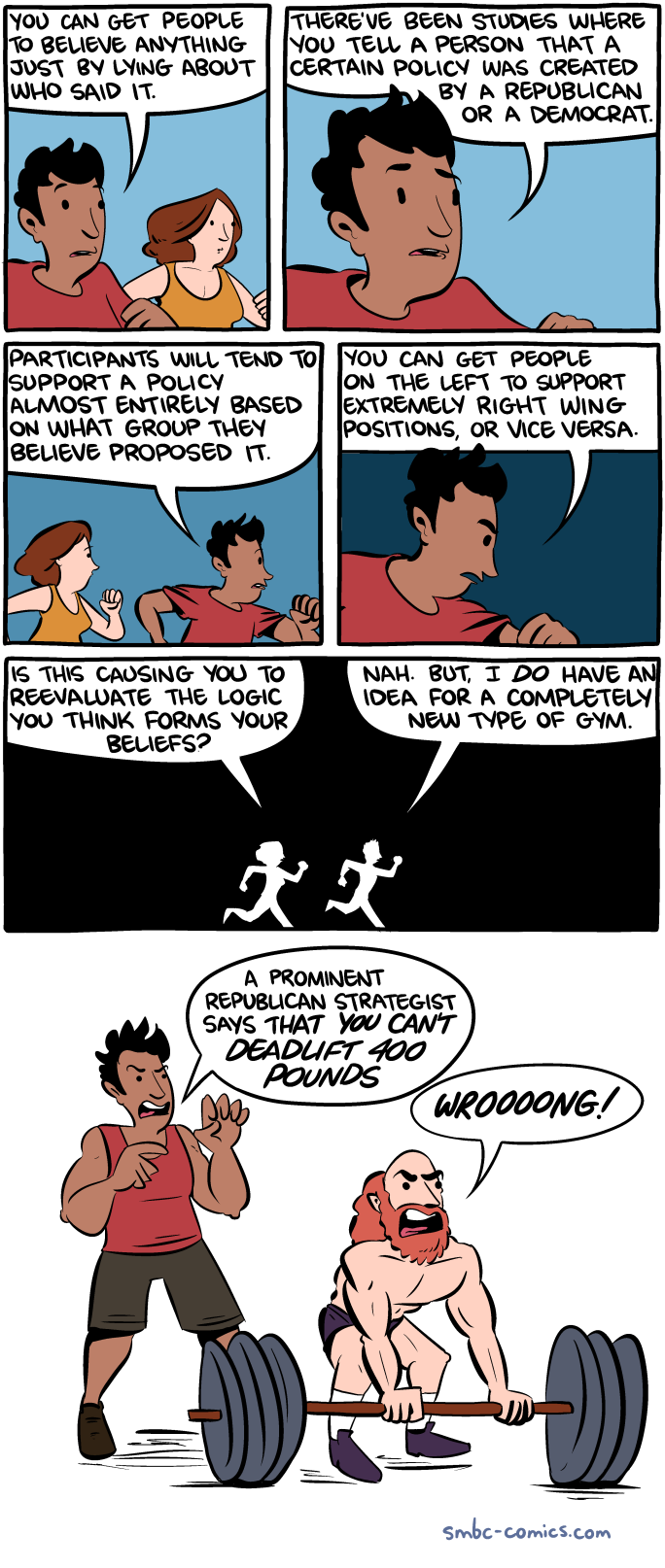
The comic discusses real psychological research showing that people can be made to believe almost anything about a policy simply by being told it was proposed by their preferred political party. A woman explains: you can get people to support extremely right-wing positions if told a Democrat proposed them, or vice versa -- participants will support a policy almost entirely based on WHO proposed it, not what it contains. A man asks: "Is this causing you to reevaluate the way you think, forms your beliefs?" The woman replies: "Nah, but I do have an idea for a completely new type of gym." The final panel shows a gym where a trainer announces: "A prominent Republican senator says that you can't deadlift 400 pounds," and a furious gym-goer lifts 400 pounds while shouting "WROOONG!"
The Humor
The comic takes a genuinely alarming finding from political psychology -- that partisan identity overrides rational evaluation of policy -- and instead of drawing a serious conclusion, pivots to an absurd entrepreneurial application. The woman completely ignores the implications for democracy and self-awareness, and instead realizes she can weaponize partisan spite to motivate people at the gym. The final panel shows this working perfectly: tell someone their political opponent says they CAN'T do something, and rage will fuel superhuman effort. The humor lies in the gap between the profound epistemological crisis the research reveals and the trivially silly use to which it is put.
References
The comic references real studies in political psychology, particularly work on partisan motivated reasoning. Research by Geoffrey Cohen (2003) and others has demonstrated that people evaluate identical policies differently depending on whether they are told the policy was proposed by Democrats or Republicans. This phenomenon is a form of identity-protective cognition.