truth
Explanation
The Joke
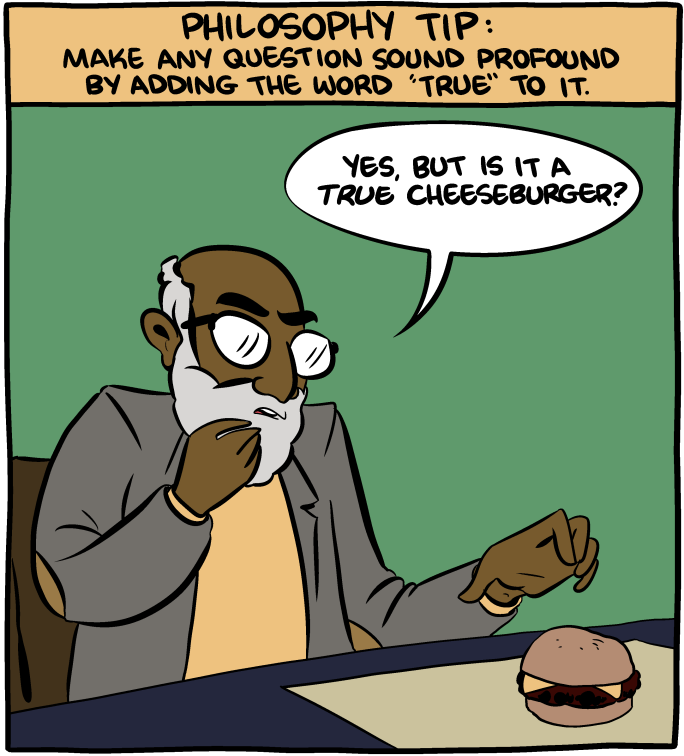
The comic presents a "Philosophy Tip" at the top: "Make any question sound profound by adding the word 'true' to it." Below, a bearded philosopher-type gazes thoughtfully at a cheeseburger on a table and asks, "Yes, but is it a TRUE cheeseburger?"
The Humor
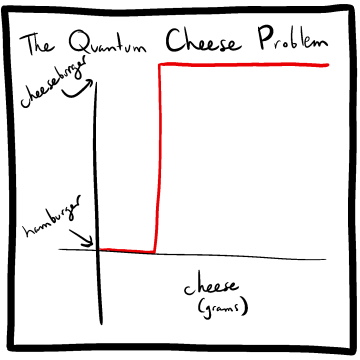
The comic lampoons a common rhetorical move in philosophy where adding qualifiers like "true" or "real" to ordinary concepts instantly makes them seem like deep metaphysical questions. Asking "What is happiness?" sounds psychological, but "What is TRUE happiness?" sounds philosophical. The joke takes this to its absurd extreme by applying the trick to a cheeseburger -- an object with no philosophical ambiguity whatsoever. Yet the question "Is it a TRUE cheeseburger?" does accidentally gesture toward real philosophical debates: What essential properties must a cheeseburger have? If you remove the cheese, is it still a cheeseburger? This is a playful jab at essentialism and Platonic idealism, where philosophers posit that things have a "true" or ideal form beyond their physical manifestation.
References
The comic alludes to several philosophical traditions. Plato's Theory of Forms holds that physical objects are imperfect copies of ideal "Forms" -- so there would indeed be a Form of the Cheeseburger against which all earthly cheeseburgers could be measured. The question also evokes the Sorites paradox (how many changes can you make before something stops being what it is) and Wittgenstein's concept of "family resemblance" in defining categories.