Understanding
Explanation
The Joke
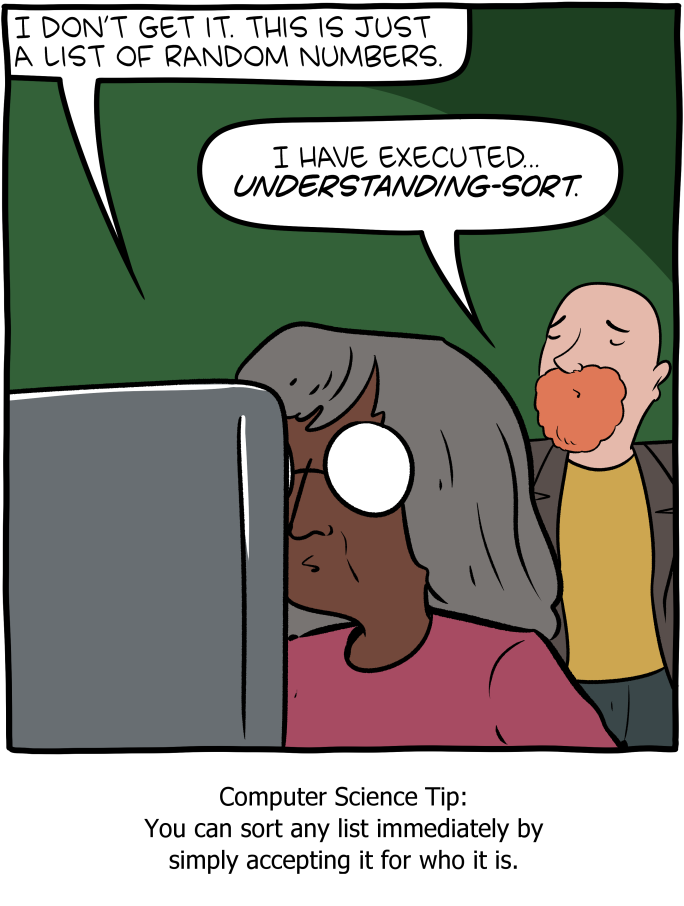
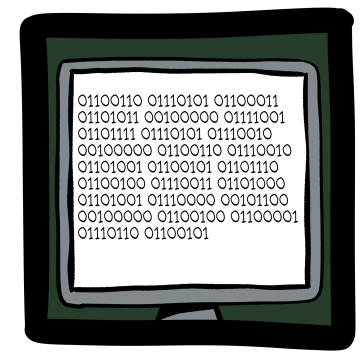
The comic shows two people looking at a computer screen. One person says "I don't get it. This is just a list of random numbers." The other person, sitting at the computer, responds with an air of serene confidence: "I have executed... UNDERSTANDING-SORT." The caption below reads: "Computer Science Tip: You can sort any list immediately by simply accepting it for who it is."
The joke inverts the concept of a sorting algorithm. In computer science, sorting algorithms (like quicksort, mergesort, bubble sort, etc.) rearrange a list of items into a specific order. "Understanding-sort" does no actual rearranging -- instead, it simply redefines "sorted" to mean "accepted as-is." The list of random numbers is declared sorted not because it has been put in order, but because the person has chosen to accept the list in its current state.
The Humor
The comedy operates on multiple levels. First, there is the computer science parody: naming a non-algorithm with the "-sort" suffix gives it a veneer of technical legitimacy, as if it belongs alongside established algorithms. The dramatic pause and bold/italic formatting of "UNDERSTANDING-SORT" adds mock gravitas to what is essentially doing nothing.
Second, the joke satirizes the self-help and mindfulness culture of radical acceptance. The caption's phrasing -- "accepting it for who it is" -- anthropomorphizes the list, using the language of emotional therapy and self-acceptance to describe data. This collision between the cold logic of computer science and the warm fuzziness of therapeutic language creates a delightful absurdity. It also plays on the idea that some problems can be "solved" simply by redefining what a solution looks like -- a comedic critique of both lazy thinking and overly permissive validation culture.
References
- Sorting algorithms are a fundamental topic in computer science, with various algorithms offering different time complexities (O(n log n) for efficient sorts like mergesort, O(n^2) for simpler ones like bubble sort).
- The joke parodies the naming conventions of sorting algorithms (quicksort, heapsort, radix sort, etc.).
- The "accepting it for who it is" language references therapeutic and mindfulness practices around radical acceptance.