unicorns-2
Explanation
The Joke
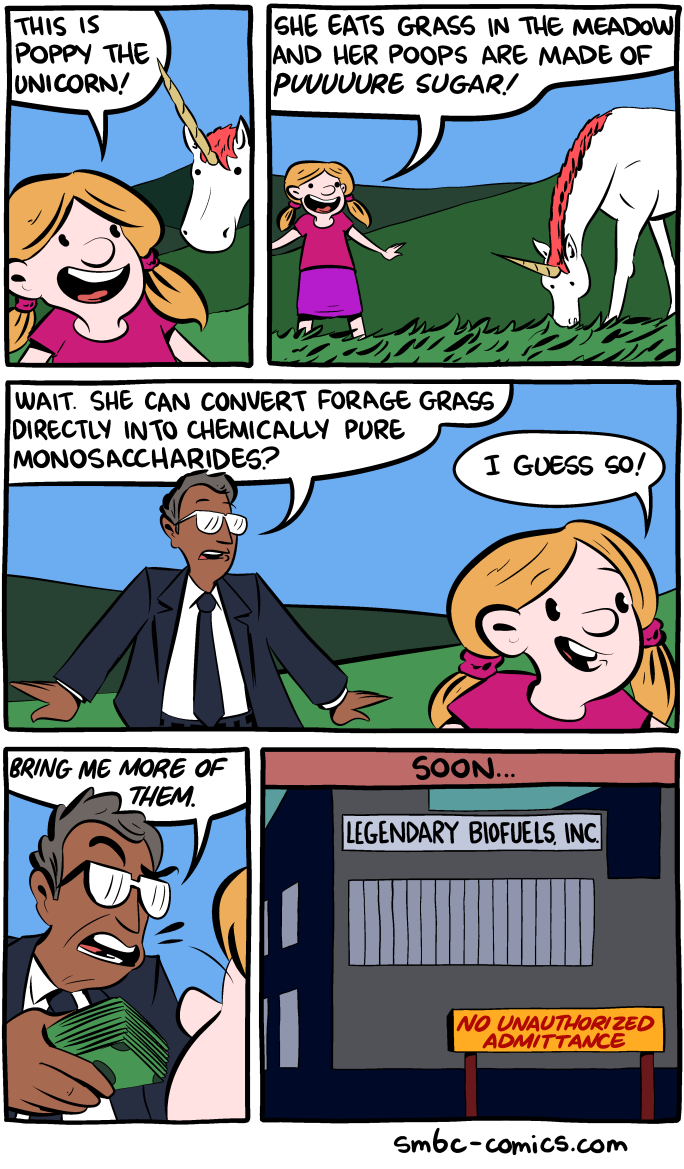
A girl introduces her unicorn, Poppy, explaining that "she eats grass in the meadow and her poop is made of pleasure sugar!" A man in a suit (likely a businessman or investor) is intrigued and asks: "Wait. She can convert forage grass directly into chemically pure monosaccharides?" The girl shrugs: "I guess so."
The man says, "Bring me more of them." The final panel, captioned "Soon...," shows a building labeled "LEGENDARY BASTELS INC" (a biotech/industrial company) with a sign reading "NO UNAUTHORIZED MAINTENANCE" -- implying the unicorns have been industrialized for mass sugar production.
The Humor
The comic takes the whimsical children's fantasy of a unicorn that poops sugar and examines it through the lens of capitalism and industrial biology. If a creature could genuinely convert grass into pure sugar (monosaccharides), that would represent an incredibly efficient and valuable biochemical process -- essentially free sugar production from cheap forage.
A rational businessman, encountering such a creature, would not marvel at its magical beauty. He would immediately recognize the commercial potential and move to industrialize it. The fantasy creature becomes livestock in a factory.
The humor comes from the collision between childlike wonder and ruthless economic logic. The little girl sees a magical pet; the businessman sees a disruptive technology in the sugar industry. The final panel's corporate building with its warning sign suggests the unicorns are now being farmed in grim industrial conditions -- a far cry from meadows and rainbow fantasies.
This is a recurring SMBC theme: taking magical or fantastical premises and following them to their logical (and often dystopian) real-world conclusions.