unified-2
Explanation
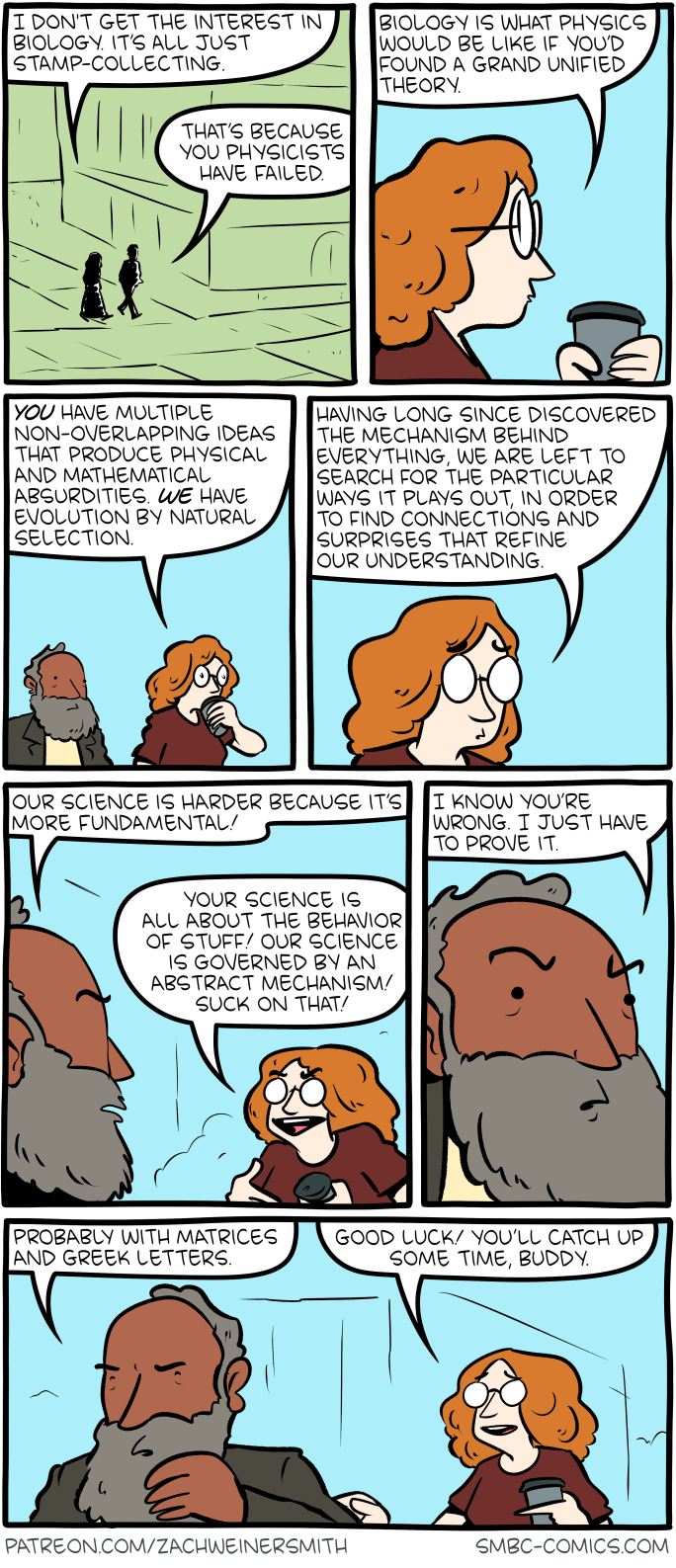
This comic is a conversation between a biologist (the red-haired woman) and a physicist (the bearded man) about the differences between their fields.
The physicist opens by saying he doesn't understand the biologist's interest in stamp collecting -- a reference to the famous (and possibly apocryphal) quote attributed to Ernest Rutherford: "All science is either physics or stamp collecting." The biologist retorts that this is because the physicist's models are all frauds -- overly simplified abstractions that don't capture the real world.
The core of the joke plays on a long-running tension between physics and biology. The physicist says biology should be able to find a "grand unified theory" like physics aspires to. The biologist explains that biology has multiple overlapping organizing ideas (genetics, evolution by natural selection, ecology, etc.) that produce physical predictions, but that living systems discovered and exploited every loophole in physical law, so biologists are left to observe the resulting complexity and try to find connections. Biology, she argues, is harder because it's less fundamentally unified.
The physicist then dismisses her field, saying "Your science is all about the behavior of physical systems governed by an electromagnetic Lagrangian, ok? Easy." The biologist responds: "I know. You just don't have to prove it." This is a cutting retort -- while it's technically true that all of biology reduces to physics, nobody can actually derive biological phenomena from the electromagnetic Lagrangian. The physicist has the luxury of a beautiful reductive claim without needing to demonstrate how to get from quantum electrodynamics to, say, the mating behavior of tree frogs.
The bottom caption reads: "Good luck -- you'll catch up in a few letters," and the physicist is left trying to match variables with hatreds. This is a joke about the complexity gap: biologists deal with vastly more variables, so "catching up" from fundamental physics to the complexity of biology would require many more equations.
The humor rests on the real philosophical debate about reductionism in science -- whether the elegant simplicity of physics is actually an advantage or whether it simply dodges the hard problem of dealing with nature's full complexity.