unintended-consequences

Explanation
The Joke
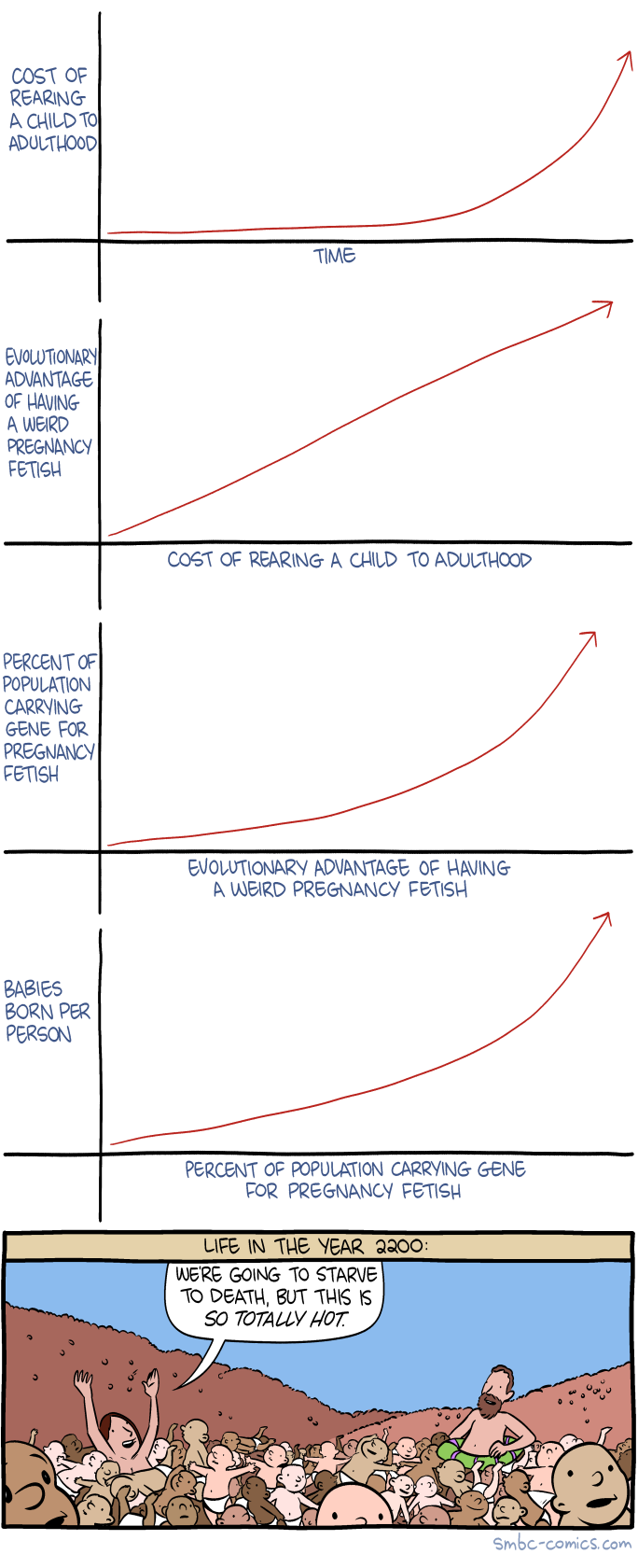
The comic presents a series of graphs that build a logical chain of absurd evolutionary reasoning. Graph 1 shows the "Cost of Rearing a Child to Adulthood" increasing exponentially over time. Graph 2 shows that as the cost of raising children increases, the "Evolutionary Advantage of Having a Weird Pregnancy Fetish" also increases -- the logic being that as children become more expensive and fewer people want them, those who are sexually attracted to pregnancy itself will have more children regardless of cost. Graph 3 shows the "Percent of Population Carrying Gene for Pregnancy Fetish" increasing with evolutionary advantage. Graph 4 shows "Babies Born per Person" increasing with the percent of the population carrying the gene.
The final panel depicts "Life in the Year 2200": a devastated, overcrowded landscape filled with babies and pregnant people everywhere, with one person exclaiming, "We're going to starve to death, but this is SO totally hot."
The Humor
The humor comes from applying seemingly rigorous evolutionary logic to reach a spectacularly absurd conclusion. Each graph in the chain is individually plausible in a hand-wavy way: rising childcare costs do create evolutionary pressure favoring those who reproduce regardless, and a fetish for pregnancy could theoretically increase reproductive output. But stacking these reasonable-sounding steps together leads to a ridiculous dystopian future where humanity breeds itself into famine because everyone finds pregnancy irresistibly attractive. The final panel perfectly captures the absurdity -- civilization is collapsing from overpopulation, but the inhabitants are too turned on to care.
References
The comic touches on real concepts in evolutionary biology, particularly the idea of selection pressure and fitness. In evolutionary terms, traits that lead to more offspring tend to become more prevalent in a population over time, regardless of whether those traits are "rational" or beneficial in other ways. The comic also references the real demographic trend of declining birth rates in developed nations as the cost of raising children increases, and humorously posits an evolutionary counter-pressure. This is a playful (if crude) application of the concept sometimes called the demographic-economic paradox.