unsolvable-
Explanation
The Joke
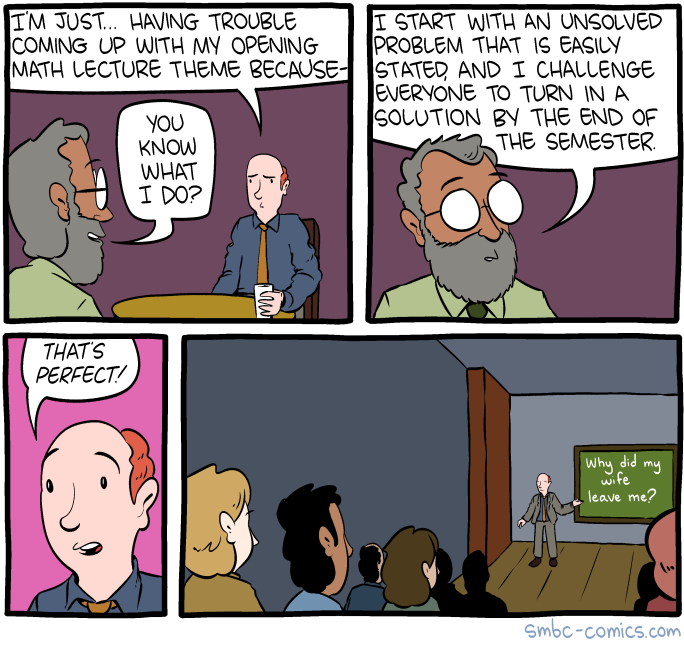
A younger man tells a bearded, older mathematician that he is having trouble coming up with an opening theme for his math lecture. The older mathematician suggests: "I start with an unsolved problem that is easily stated and I challenge everyone to turn in a solution by the end of the semester." The younger man exclaims "That's perfect!" In the final panel, we see the older mathematician standing before a lecture hall with a chalkboard that reads: "Why did my wife leave me?"
The twist is that the "unsolved problem that is easily stated" turns out not to be a mathematical problem at all, but a deeply personal one -- his wife leaving him. He has repackaged his emotional pain as an academic exercise, presenting it to a room full of students as though it were a legitimate unsolved problem in mathematics.
The Humor
The joke operates on a bait-and-switch structure. The setup leads the audience to expect a clever pedagogical technique involving famous unsolved mathematical problems (like the Goldbach conjecture or the Collatz conjecture -- problems that are easy to state but notoriously difficult to solve). The punchline subverts this by revealing the professor is really just a sad, divorced man desperately seeking answers to his personal life through the only framework he knows: academia. It plays on the stereotype of the emotionally stunted academic who cannot separate professional and personal life, and who processes all of life's difficulties through the lens of intellectual inquiry.
References
The concept of "easily stated but unsolved problems" is a well-known category in mathematics, including famous examples like Fermat's Last Theorem (solved in 1995), the Goldbach Conjecture, and the Twin Prime Conjecture.