util
Explanation
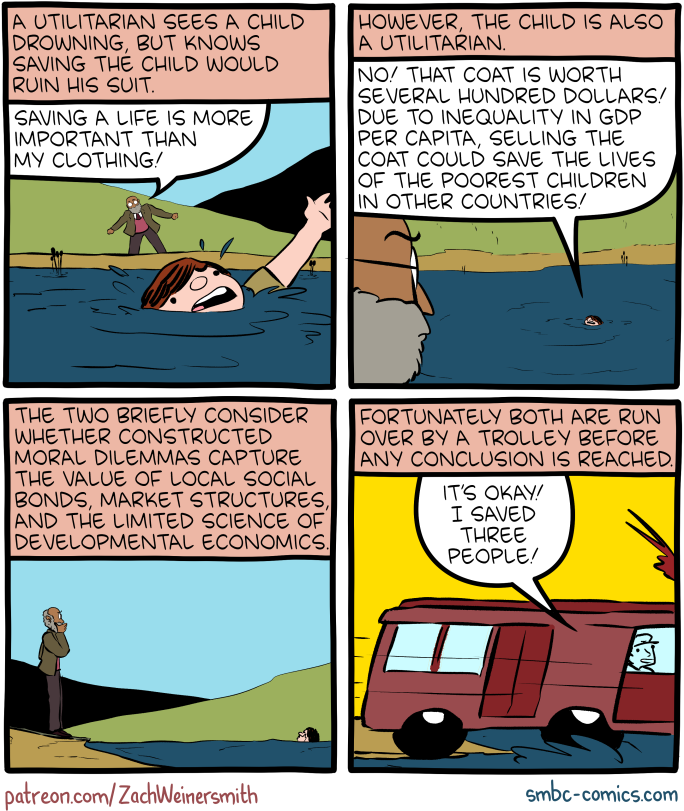
This multi-panel comic tackles utilitarian ethics through a drowning-child thought experiment. In the first panel, a utilitarian sees a child drowning and thinks about whether to save the child. The utilitarian reasons: "A utilitarian sees a child drowning, but knows saving the child would ruin his clothing, which is more important than a single child's life." But then the next panel adds: "However, the child is also a utilitarian." The child calculates: "My food costs in a wealthy nation could save dozens of lives per capita. Selling the value of my rescue to save the poorest children of the poorest countries..."
The comic then escalates: "The two briefly converse and then both agree it'd be more efficient to go door to door asking for donations." They are shown going door to door together (the child apparently rescued or having rescued themselves). But then: "It's chaos. They convince everyone. The economy collapses."
The joke satirizes utilitarian moral reasoning by showing how it can lead to absurd conclusions when taken to its logical extreme. The classic "drowning child" thought experiment (associated with philosopher Peter Singer) is meant to illustrate that we have a moral obligation to help others when the cost to ourselves is small. But the comic pushes utilitarian logic further: if maximizing utility is all that matters, then every action leads to a chain of further calculations, and the "optimal" outcome keeps shifting. The child being a utilitarian too creates an infinite regress of utilitarian reasoning.
The final punchline -- that convincing everyone to be perfectly utilitarian causes the economy to collapse -- is a pointed critique of the gap between utilitarian theory and practical reality. It suggests that a world of perfect utilitarian agents might actually be dysfunctional, because the economic system depends on people acting in self-interested ways that utilitarianism would condemn. The comic captures a real tension in moral philosophy between what is theoretically optimal and what actually works in practice.