utilitarian
Explanation
The Joke
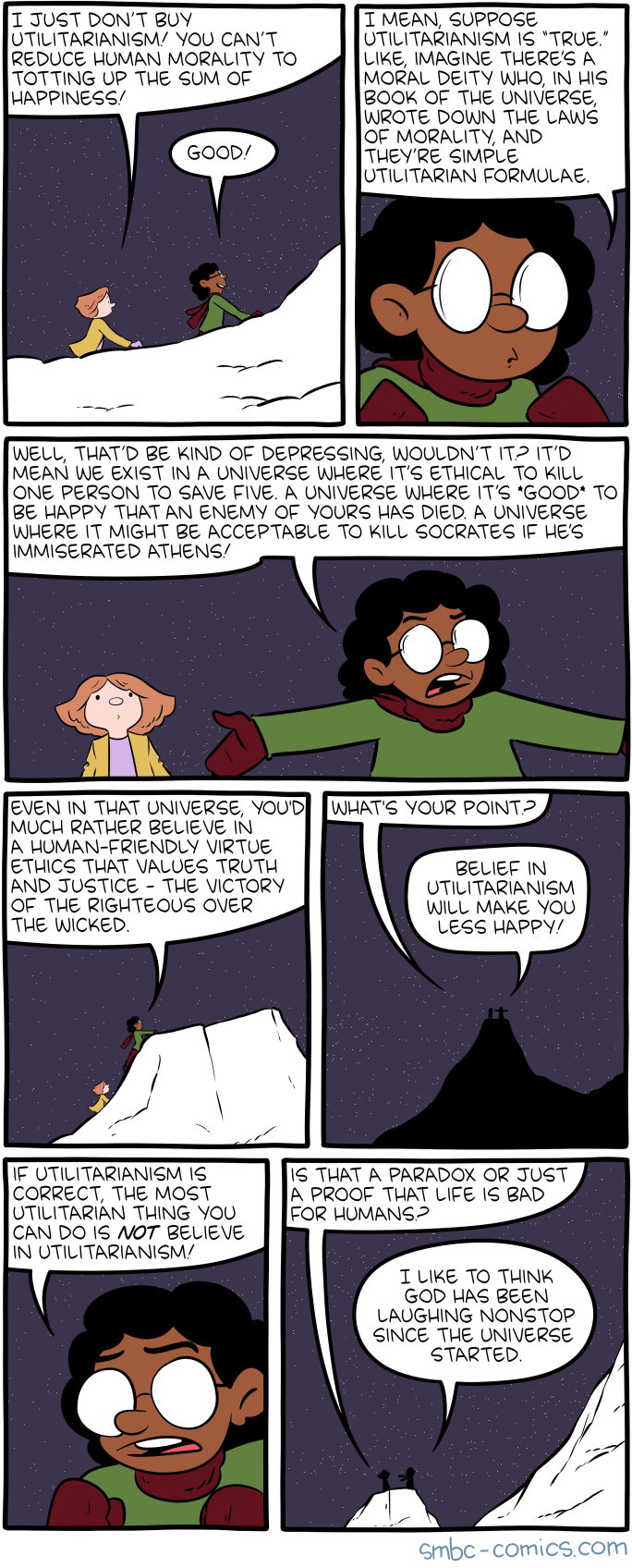
Two people are having a late-night conversation in bed about utilitarianism. One person says they just don't buy utilitarianism -- that you can't reduce human morality to "totting up the sum of happiness." The other person responds that even if utilitarianism is "true," it would lead to strange and unsettling conclusions: imagine a universe where it is good to harvest organs from one person to save five, or where it might be acceptable to kill Socrates if his death maximized overall utility.
The first person asks what the point is. The second explains: even in that universe, "kindness" would still be a human-friendly virtue because the moral calculus is so complex that no one can do the math in real time, so the best practical policy would be to just be kind. Thus, "if utilitarianism is true, the utilitarian thing for you to do is not be a utilitarian" -- meaning you should not try to calculate utility in every situation, because your calculations will be wrong and harmful. Better to just follow simple heuristic rules like "be kind."
The first person pauses and says they like to think about this conversation whenever they see a utilitarian laughing. They imagine the utilitarian was "laughing none too hard, once the laughter started." The comic ends on this wry note.
The Humor
The joke is a philosophical paradox delivered as pillow talk. The punchline -- "the utilitarian thing is to not be a utilitarian" -- is a genuinely clever argument in moral philosophy. If the calculations required for true utilitarianism are beyond human capacity, then a utilitarian should rationally adopt simpler moral rules (like "be kind"), which means acting like a non-utilitarian. It is a self-defeating philosophy in practice. The humor also comes from the setting: this dense philosophical argument is happening as a casual bedtime conversation, treating one of ethics' thorniest debates as the kind of thing couples chat about before falling asleep.
References
Utilitarianism is a moral philosophy most associated with Jeremy Bentham and John Stuart Mill, which holds that the right action is the one that maximizes overall happiness or well-being. The "harvest organs from one to save five" thought experiment is a classic objection to utilitarian reasoning, often attributed to Judith Jarvis Thomson's trolley problem variants.