utilitarian-judgment

Explanation
The Joke
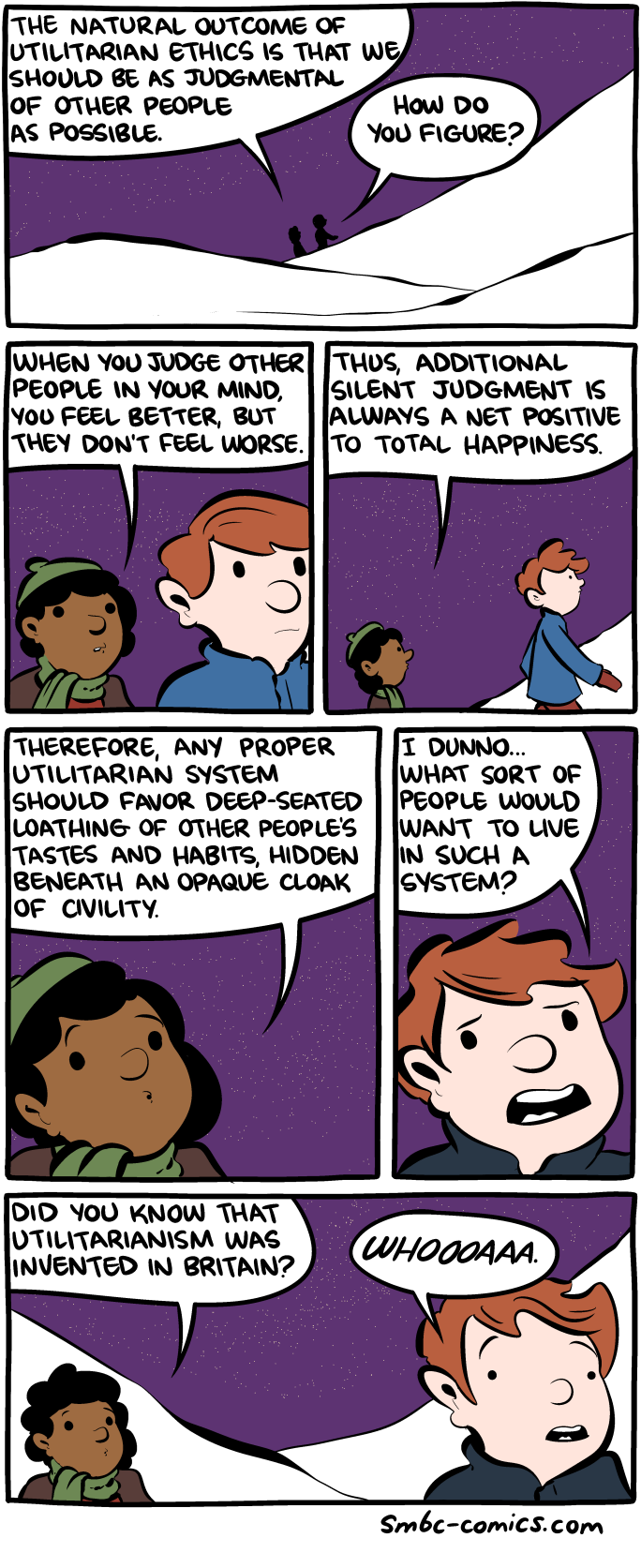
A character argues that the natural outcome of utilitarian ethics is that we should be as judgmental of other people as possible. His reasoning: when you silently judge other people, you feel better (a boost to your happiness), but they don't feel worse (since they don't know about it). Therefore, silent judgment is a net positive to total happiness, and any proper utilitarian system should encourage deep-seated criticism of other people's tastes, habits, and appearance. When asked what sort of people would want to live in such a system, he deflects with: "Did you know that utilitarianism was invented in Britain?" — prompting an impressed "Whoooaaa" from the audience.
The Humor
The comic is a reductio ad absurdum of utilitarian ethics. Utilitarianism, in its simplest form, says we should maximize total happiness. The character exploits this by pointing out that private, unexpressed judgments create pleasure for the judge without harming the judged — so they're a "free" source of happiness. This is technically consistent with a naive reading of utilitarianism but clearly absurd, revealing how the philosophy can be twisted to justify petty and mean-spirited behavior. The final punchline — deflecting to a factoid about Britain inventing utilitarianism — is a non sequitur that satirizes how people in debates will dodge uncomfortable conclusions by changing the subject to an impressive-sounding but irrelevant fact. The audience's awed reaction to this trivial deflection adds another layer, mocking how easily people are distracted from logical problems.
References
Utilitarianism is the ethical theory developed primarily by Jeremy Bentham and John Stuart Mill in 18th-19th century Britain. It holds that the best action is the one that maximizes overall utility, typically defined as happiness or well-being. The comic's claim that it was "invented in Britain" is accurate — Bentham (1748-1832) and Mill (1806-1873) were both English philosophers.